How to Preheat an Air Fryer: 5 Easy Steps for Crispier Food (2026 Guide)
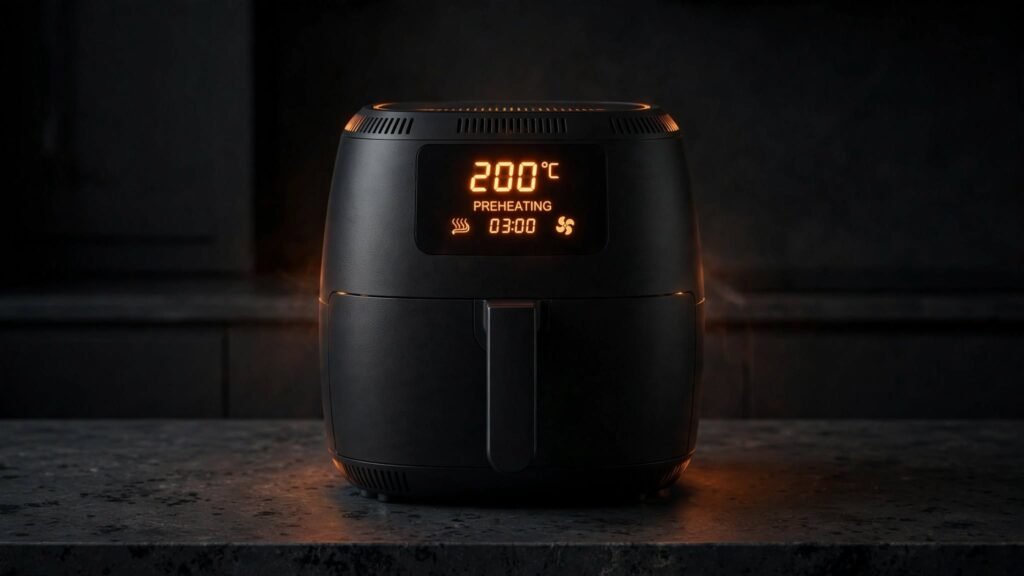
Preheating an air fryer is simple, but you do not necessarily need to do it for every recipe.
For foods that benefit from a hot cooking surface and immediate exposure to the target temperature, preheating can help with browning and crisping. For other foods, especially recipes that already provide specific instructions, skipping the preheat may be perfectly fine.
The important part is knowing when preheating is useful, how to do it correctly, and when not to bother.
In this guide, you’ll learn how to preheat an air fryer, how long it usually takes, what temperature to use, which foods may benefit from preheating, and the mistakes that can affect your results.
If you are completely new to air frying, start with our guide on How to Use an Air Fryer for the basic cooking process and controls.
Do You Need to Preheat an Air Fryer?
No, not every time.
Whether you should preheat depends on the recipe, the food, and your particular air fryer.
Some recipes are written for a preheated appliance. Others are designed to start cooking immediately. Many foods will cook successfully either way, although the texture, browning, or cooking time can change slightly.
Preheating is most useful when the recipe benefits from starting in an already-hot environment. This can be particularly helpful for foods where surface browning or crispness is important.
A good rule is:
If the recipe specifically tells you to preheat, follow it. If it does not, check your air fryer instructions and consider whether the food benefits from a hot start.
You don’t need to turn preheating into a ritual before every meal.
How to Preheat an Air Fryer in 5 Easy Steps
Most basket-style air fryers are straightforward to preheat. The controls differ between models, so your owner’s manual should take priority if it gives different instructions.
1. Check the Manufacturer’s Instructions
Start by checking the instructions for your specific air fryer.
Some models have a dedicated preheat function. Others simply allow you to set the cooking temperature and run the appliance before adding the food.
Do not assume every air fryer operates in exactly the same way.
2. Put the Basket or Cooking Rack in Place
For many basket-style models, the basket can remain inside while the appliance heats.
If your model uses a removable rack, tray, or another cooking accessory, follow the instructions supplied with the appliance.
The goal is to have the cooking chamber ready for the food when the preheating period is finished.
3. Set the Recipe’s Cooking Temperature
Set the appliance to the temperature specified by your recipe.
For example:
- Recipe says 350°F → preheat to 350°F
- Recipe says 375°F → preheat to 375°F
- Recipe says 400°F → preheat to 400°F
There is no advantage to automatically choosing the highest temperature.
Preheating means bringing the appliance toward the intended cooking temperature, not overheating it.
4. Start the Air Fryer
If your model has a preheat setting, use it according to the manufacturer’s instructions.
If it does not, you may need to set the temperature and run the appliance for a short period before adding the food.
The exact heating behavior varies by model, so don’t treat a timer from another air fryer as an exact requirement for yours.
5. Add the Food and Begin Cooking
Once the air fryer has reached its preheated state, carefully place the food into the basket.
Arrange the food according to the recipe, leaving enough space for hot air to circulate when appropriate.
Then cook using the recipe’s recommended temperature and timing.
If you’re unsure about basic basket arrangement, food placement, shaking, or turning, our How to Use an Air Fryer guide covers those fundamentals separately.
How Long Does It Take to Preheat an Air Fryer?
There is no single preheating time that applies to every air fryer.
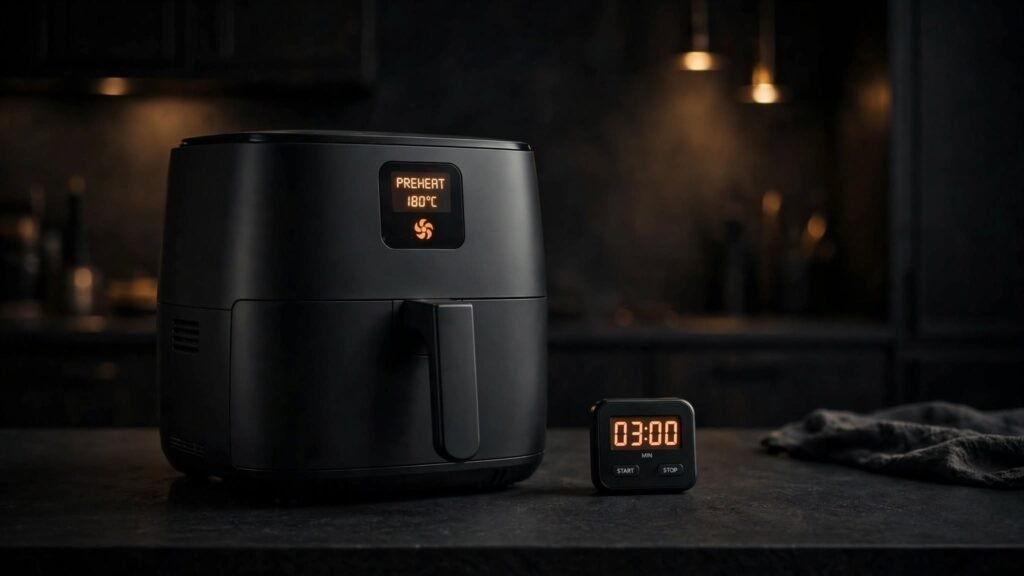
Many compact basket-style models can become ready within a few minutes, but the actual time depends on factors such as:
- Air fryer size
- Heating system
- Cooking chamber design
- Starting temperature
- Model-specific programming
- Whether the appliance has a dedicated preheat cycle
A 3-to-5-minute range is often used as a general starting point for smaller basket-style air fryers, but it should not be treated as a universal specification.
If your air fryer has an automatic preheat program, follow that program.
If the recipe gives a specific preheating instruction, use it unless your appliance manual says otherwise.
Why Doesn’t Every Air Fryer Preheat at the Same Speed?
A small basket-style appliance has a much smaller cooking chamber than a large air fryer oven.
The heating element, fan, chamber size, and temperature-control system also differ between models.
That is why copying the exact preheat time from somebody else’s air fryer can be misleading.
The appliance’s instructions are more useful than a universal number.
What Temperature Should You Preheat an Air Fryer To?
Use the same temperature specified for cooking, unless the recipe or manufacturer gives different instructions.
For example, if the recipe says to cook at 375°F, preheat to 375°F.
There is usually no reason to preheat at 450°F and then reduce the temperature after adding the food.
A hotter starting temperature can cause the outside of some foods to brown before the center has finished cooking.
The purpose of preheating is to create the appropriate starting environment, not simply to make the appliance as hot as possible.
When Is Preheating Useful?
Preheating is particularly useful when the recipe benefits from immediate exposure to the target cooking temperature.
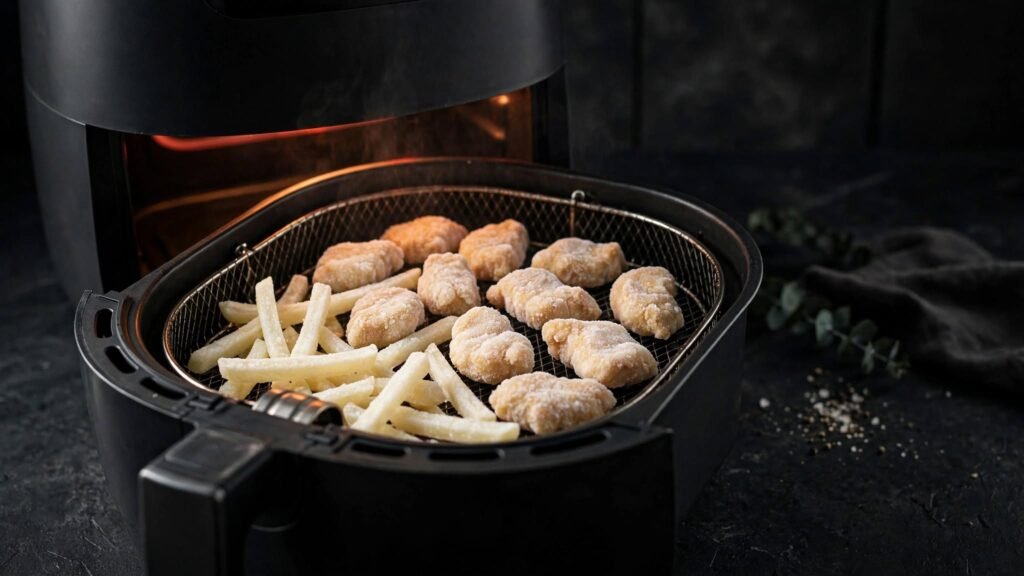
Crispy Frozen Foods
Frozen foods such as fries, breaded foods, and some appetizers can benefit from a hot start.
The preheated chamber allows cooking to begin at the target temperature instead of spending part of the cooking period heating the appliance.
However, always follow the instructions on the food package or recipe when available.
Foods Where Browning Matters
Preheating can be useful when you’re trying to develop a browned exterior.
Examples can include:
- Breaded chicken
- Onion rings
- Potato products
- Some roasted vegetables
- Certain meat preparations
The final result still depends on moisture, food thickness, airflow, quantity, and cooking time.
Preheating alone cannot guarantee crisp food.
Steak and Other Foods Requiring a Hot Start
Some steak recipes call for a preheated air fryer because the recipe is designed around starting the meat in a hot cooking environment.
In this situation, preheating can help the exterior begin browning sooner.
The exact temperature and cooking time should come from a reliable recipe and should be adjusted for the steak’s thickness and desired doneness.
Recipes That Specifically Require Preheating
This is the simplest situation.
If the recipe says to preheat, follow the recipe.
You don’t need to second-guess the instruction simply because another air-fryer recipe doesn’t require preheating.
When Can You Skip Preheating?
Skipping preheating isn’t automatically a mistake.
There are several situations where it may make little practical difference, depending on the recipe and appliance.
Recipes Designed for a Cold Start
Some recipes are intentionally designed to begin with a cold appliance.
If the recipe provides instructions for starting without preheating, follow them rather than adding an extra heating step.
Foods With Longer Cooking Times
For foods that spend a relatively long time cooking, the initial preheating period may be less important than it is for a quick-cooking food.
However, this does not mean every long-cooking food should start cold.
The recipe still comes first.
Certain Baked Foods
Baked foods can be more sensitive to how heat reaches the exterior and center.
A cake, bread, pastry, or other delicate preparation may have specific instructions about preheating.
Don’t automatically apply the same preheating rule you use for frozen fries.
When the Manufacturer Says Not to Preheat
Your air fryer manual takes priority over general internet advice.
If the manufacturer specifies a particular cooking procedure, use that procedure.
Preheating vs. Starting Cold
| Method | Potential advantage | Possible drawback |
|---|---|---|
| Preheated | Food starts cooking in a hot chamber | Adds a short waiting period |
| Cold start | Simpler and immediately begins the cooking cycle | Cooking time may need to account for heating |
| Recipe-specific method | Follows the intended cooking process | Requires checking the recipe |
There isn’t a universal winner.
The better choice is the one that matches the food, recipe, and appliance.
Does Preheating Make Food Crispier?
It can help, but preheating is not the only factor that determines crispiness.
Crispness is affected by several things:
- Surface moisture
- Food quantity
- Airflow
- Food arrangement
- Cooking temperature
- Cooking time
- Coating or breading
- The food itself
For example, putting a large amount of wet food into a small basket can restrict airflow and create a softer result even if the appliance was properly preheated.
So if your food isn’t crispy, don’t automatically assume that you simply need to preheat longer.
How the food is arranged can matter just as much.
Does Preheating Reduce Cooking Time?
Sometimes, but you shouldn’t assume that it will always produce a specific time saving.
When an appliance is already hot, the food doesn’t have to spend the beginning of the cooking process waiting for the chamber to reach the target temperature.
However, air-fryer cooking times vary significantly with:
- Food thickness
- Food quantity
- Starting temperature
- Appliance model
- Basket design
- Recipe
- Desired doneness
For this reason, avoid subtracting an arbitrary number of minutes from every recipe just because you preheated.
Use the recipe as your starting point and check the food as it approaches doneness.
Common Air Fryer Preheating Mistakes
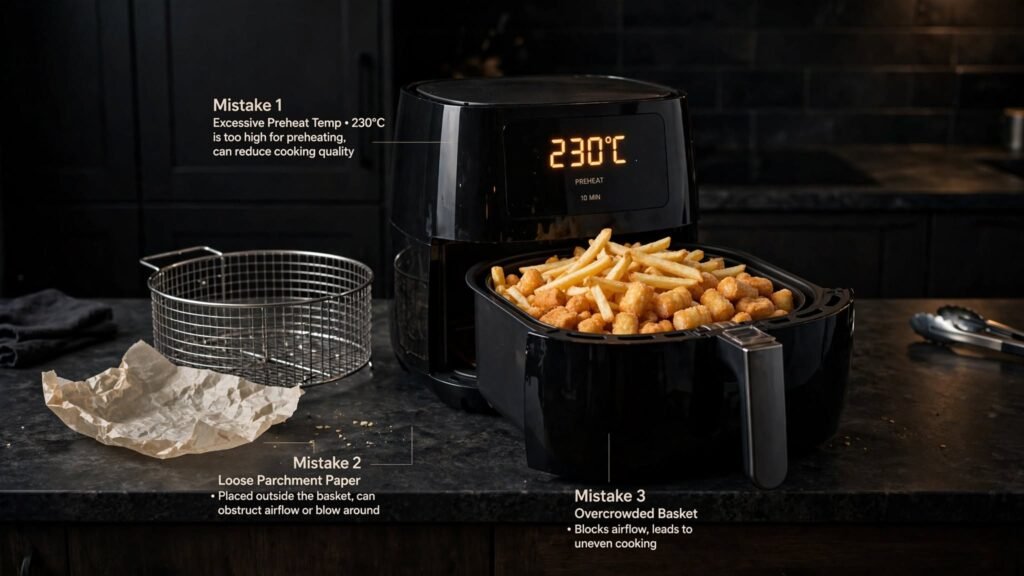
Preheating for Too Long
Running the appliance far longer than necessary doesn’t automatically improve the food.
Use the manufacturer’s preheat function or the recipe’s instructions when available.
Setting the Temperature Too High
Preheating at an unnecessarily high temperature can cause the exterior of food to brown too quickly.
Set the temperature the recipe actually calls for.
Treating Every Air Fryer the Same
A compact basket model and a large air fryer oven don’t necessarily heat in the same way.
Model differences matter.
Adding Food Before the Preheat Is Complete
If a recipe specifically calls for preheating, adding the food too early changes the cooking process.
Wait until the preheating stage is complete.
Using Loose Parchment Paper During Preheating
Do not put loose parchment paper into an empty, operating air fryer.
The fan can move lightweight paper toward the heating element.
If you use parchment paper during cooking, make sure it is used according to the appliance manufacturer’s instructions and is properly secured by food.
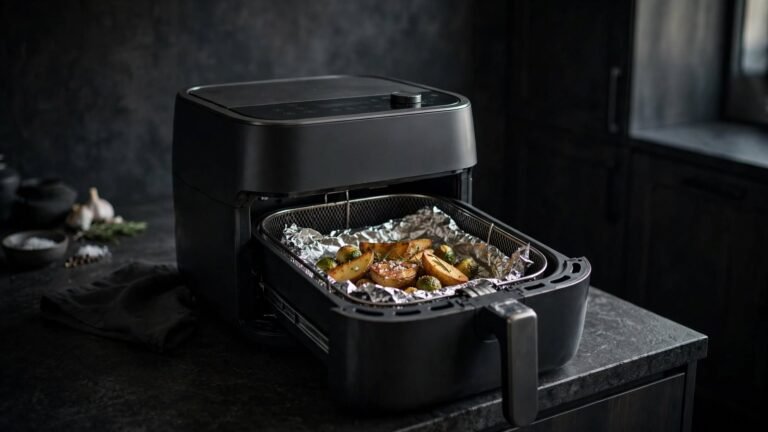
If you’re deciding between foil and other basket-lining options, our guide on [Can You Put Aluminum Foil in an Air Fryer?] explains the safety and airflow considerations separately.
Ignoring the Recipe
A recipe’s cooking method is part of the recipe.
If it says to start cold, don’t automatically preheat. If it says to preheat, don’t assume the step is pointless.
Can You Preheat an Air Fryer With the Basket Inside?
For many basket-style air fryers, yes, the basket can remain inside during preheating.
However, this is not a universal rule for every design.
Some appliances use different baskets, racks, trays, or heating configurations. Always follow the instructions supplied with your model.
If your air fryer has a dedicated preheat program, that is generally the easiest option.
Should You Preheat an Air Fryer for Frozen Fries?
Preheating can be useful for frozen fries, particularly when the recipe or package instructions call for it.
A hot cooking chamber gives the fries an immediate start at the intended cooking temperature.
But crispiness also depends heavily on batch size and airflow.
Avoid packing the basket too tightly. If the fries are crowded, moisture can remain around the food and interfere with browning.
The cooking instructions on the package should remain your primary starting point because frozen fries vary considerably in thickness, coating, and preparation.
Should You Preheat an Air Fryer for Steak?
Preheating can be useful for steak recipes that are designed around a hot starting environment.
A preheated appliance allows the exterior to begin heating immediately, which can support browning.
But steak thickness matters enormously.
A thin steak and a thick steak should not automatically receive the same cooking time.
For food safety and doneness, use a reliable food thermometer rather than judging the center entirely by appearance.
What About Preheating for Chicken?
Whether to preheat chicken depends on the recipe and the size of the pieces.
Thin chicken pieces may benefit from a hot start when the recipe is designed around browning.
Thicker chicken can require more careful temperature and timing management because the center needs to reach a safe internal temperature without excessively drying the exterior.
Don’t use preheating as a substitute for checking doneness.
How to Tell When the Air Fryer Is Ready
The easiest method is to use the appliance’s built-in preheat program if it has one.
If your model does not have a dedicated preheat function, follow its instructions for manual preheating.
Avoid relying on assumptions such as:
“Every air fryer reaches temperature in exactly three minutes.”
It doesn’t.
The appliance’s size and heating system affect how quickly it reaches the desired temperature.
Frequently Asked Questions
Do you have to preheat an air fryer?
No. Some recipes benefit from preheating, while others do not require it. Follow the recipe and your air fryer’s instructions.
How long should you preheat an air fryer?
Many smaller basket-style air fryers can preheat within a few minutes, but the exact time varies by model. A 3-to-5-minute range can be a general starting point, not a universal rule.
What temperature should I preheat my air fryer to?
Usually, use the cooking temperature specified by the recipe. If the recipe says 375°F, preheat to 375°F unless the appliance instructions say otherwise.
Can you preheat an air fryer empty?
Yes, when the appliance’s instructions or recipe call for preheating. Keep loose materials such as parchment paper out of an empty operating air fryer because the fan can move them toward the heating element.
Is preheating better for frozen foods?
It can be useful for many frozen foods, particularly those where a crisp exterior is desired. Follow the package or recipe instructions for the specific food.
Can I skip preheating?
Yes, when the recipe does not require it and your appliance instructions permit cooking without a preheat cycle. The result may differ slightly depending on the food and recipe.
Does preheating make an air fryer cook faster?
It can reduce the amount of cooking time spent bringing the cooking chamber up to temperature, but it does not guarantee a specific reduction in recipe time.
Should I preheat for every recipe?
No. Preheating should be based on the recipe, food, and appliance rather than treated as a mandatory step for every meal.
Final Conclusion:
Should You Preheat an Air Fryer?
Preheating is useful, but it isn’t mandatory for every air-fryer recipe.
Use it when the recipe calls for a hot start or when starting in a preheated chamber is useful for the type of food you’re cooking. Frozen foods, some breaded foods, and recipes where browning matters may benefit from it.
For other recipes, especially those specifically designed for a cold start, there is no reason to add an unnecessary preheating step.
The safest and most reliable approach is straightforward:
- Check your air fryer’s instructions.
- Follow the recipe’s preheating directions.
- Use the recipe’s cooking temperature.
- Don’t assume every air fryer heats at the same speed.
- Judge the food by doneness, not just by the clock.
Once you know when preheating actually serves a purpose, you can stop treating those extra few minutes as a mandatory ritual and use them when they genuinely improve the cooking process.