How Many Watts Should an Air Fryer Have? A Practical Guide
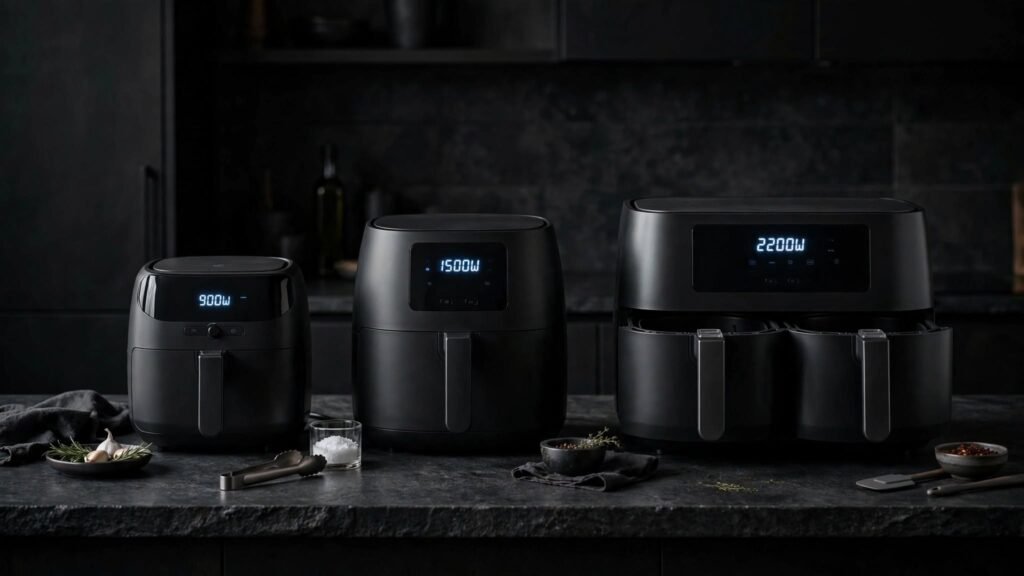
How Many Watts Should an Air Fryer Have? For many households, 1,400 to 1,700 watts is a practical range to consider when choosing an air fryer. Smaller models can work well around 1,000 to 1,300 watts, while larger-capacity and multi-basket models may use 1,700 watts or more.
But wattage isn’t a complete measure of an air fryer’s performance.
A higher wattage rating means the appliance can draw more electrical power, but it doesn’t automatically mean faster cooking or crispier food. Basket capacity, airflow, heating design, temperature control, and the amount of food you put inside all matter.
So instead of choosing the air fryer with the biggest wattage number, match the power rating to the size of the appliance and the way you actually cook.
What Does Wattage Mean on an Air Fryer?
Wattage measures electrical power.
An air fryer rated at 1,500 watts can draw up to 1,500 watts when its heating system is operating at its rated maximum. The number tells you how much electrical power the appliance is designed to use, but it doesn’t tell you exactly how well it will cook.
Two air fryers with similar wattage can perform differently because their:
- Heating elements may have different designs
- Fans and airflow paths may differ
- Baskets may have different shapes
- Cooking surfaces may be different
- Temperature controls may behave differently
- Capacities may vary
This is why wattage is best considered alongside the rest of the appliance’s specifications.
How Many Watts Does a Typical Air Fryer Have?
Air fryer wattage varies by size and design.
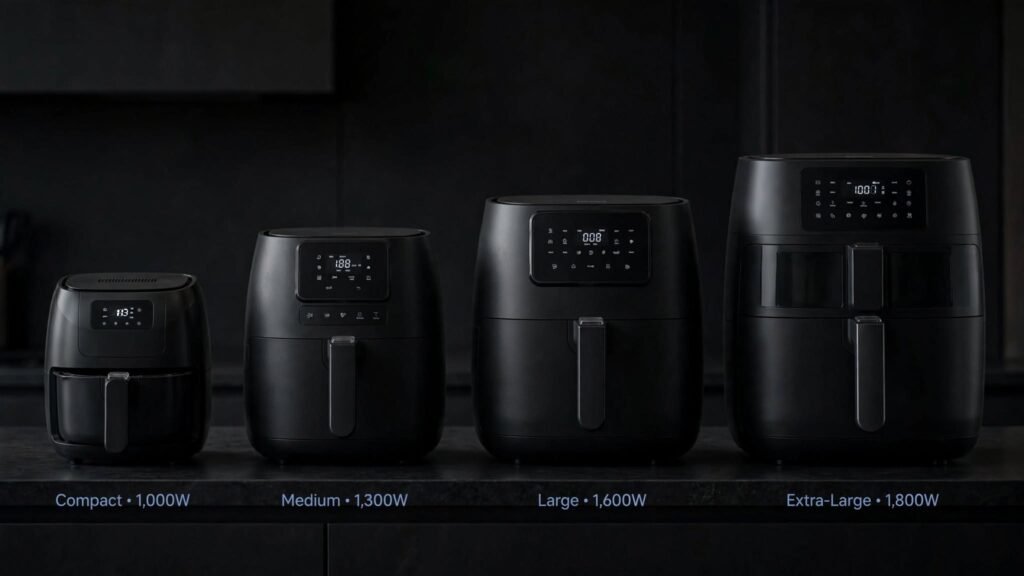
Compact models can use around 800 to 1,300 watts, while many standard household models fall around 1,200 to 1,800 watts. Larger or multi-basket appliances can use more.
These ranges are useful for comparison, but they aren’t strict industry categories.
| Air Fryer Type | Approximate Wattage | Typical Use |
|---|---|---|
| Compact | 800–1,300W | Small portions and snacks |
| Small/medium | 1,200–1,500W | Everyday cooking for 1–2 people |
| Medium/large | 1,400–1,800W | Family meals and larger portions |
| Large/multi-basket | 1,700–2,000W+ | Large batches and multiple foods |
Always check the manufacturer’s specifications for the exact model you’re considering.
How Many Watts Should Your Air Fryer Have?
The right wattage depends mainly on capacity, portion size, and how often you cook larger batches.
For One Person
If you mostly cook single portions, snacks, vegetables, or reheated food, around 1,000 to 1,300 watts may be sufficient.
There isn’t much reason to buy a large, high-powered appliance if you rarely use its capacity.
A compact air fryer may also take up less counter space and be easier to store.
For Two People
For two people, around 1,200 to 1,500 watts is a reasonable range to consider.
This can cover many everyday uses, including:
- Chicken
- Vegetables
- Frozen foods
- French fries
- Fish
- Reheating leftovers
If you regularly cook large portions, capacity may matter more than choosing a higher wattage.
For a Small Family
For three or four people, 1,400 to 1,700 watts is a practical starting point.
At this size, pay close attention to basket capacity.
A high-wattage air fryer with a small basket may still require several batches if you normally cook for a family.
For Large Families and Batch Cooking
If you frequently cook large quantities, consider 1,600 to 1,800 watts or more, depending on the appliance’s capacity.
Some large-capacity and multi-basket models use 1,800 watts or more.
The goal isn’t to buy the highest wattage available. It’s to find an appropriate balance between power, capacity, and airflow.
Air Fryer Wattage by Household Size
| Cooking Situation | Practical Wattage to Consider |
|---|---|
| One person, small portions | 1,000–1,300W |
| Two people | 1,200–1,500W |
| Three to four people | 1,400–1,700W |
| Large family | 1,600–1,800W+ |
| Frequent large-batch cooking | 1,700W+ |
These ranges overlap because household size isn’t the only factor.
Two people who regularly cook large batches may need a bigger air fryer than a family of four that mainly uses one for small side dishes.
Does Higher Wattage Mean Better Cooking?
Not necessarily.
Higher wattage can provide more electrical power for heating and may help an air fryer recover heat after cold food is added or the basket is opened.
But cooking performance depends on more than the heating element.
Other factors include:
- Airflow
- Basket design
- Food quantity
- Food moisture
- Cooking temperature
- Heating-element design
- Cooking surface
For example, a well-designed 1,500-watt air fryer may be a better fit for your needs than a poorly matched 1,800-watt model.
The wattage number should therefore be part of the buying decision, not the entire decision.
Wattage vs. Basket Size
Wattage makes more sense when you consider it alongside basket capacity.
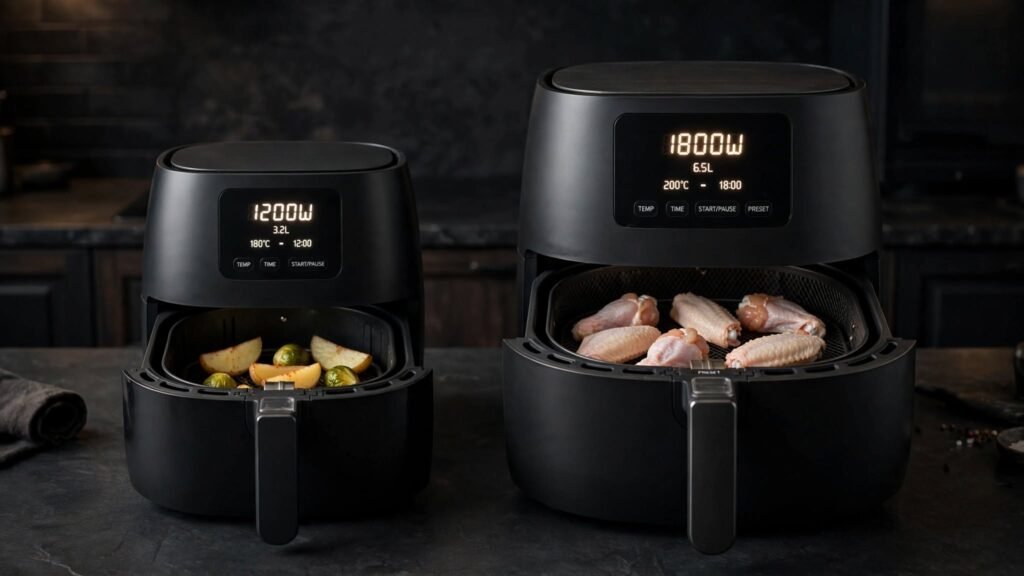
A larger basket can hold more food, which means the appliance may need to handle a larger cooking load.
But you shouldn’t assume that every large air fryer needs the highest wattage available. Manufacturers use different heating systems, fan designs, and basket configurations.
When comparing two models, look at:
Wattage + capacity + cooking surface + airflow
That combination gives you a much better idea of whether the appliance suits your cooking habits.
Basket loading matters too. If food is packed tightly together, airflow around the food can be restricted, which can affect cooking and browning.
Does a Higher-Wattage Air Fryer Use More Electricity?
It can, when comparing appliances operating for the same amount of time.
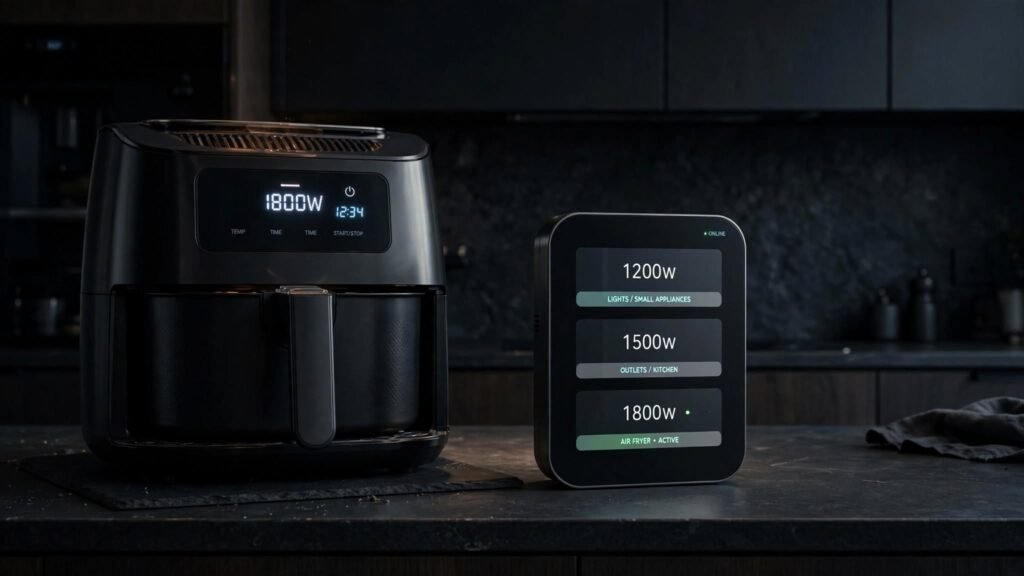
A 1,800-watt air fryer draws more electrical power than a 1,200-watt model while both are operating at their rated power.
However, wattage isn’t the same thing as total energy consumption.
The basic calculation is:
Energy used (kWh) = watts × operating hours ÷ 1,000
For example, if a 1,500-watt air fryer operated continuously at its rated power for 20 minutes:
1,500 × 0.333 ÷ 1,000 ≈ 0.50 kWh
Actual consumption can be lower or different because heating elements may cycle on and off during a cooking program.
A simple comparison
An 1,800-watt air fryer running for 10 minutes would theoretically use:
1,800 × 0.167 ÷ 1,000 ≈ 0.30 kWh
A 1,200-watt air fryer running for 15 minutes would use:
1,200 × 0.25 ÷ 1,000 = 0.30 kWh
So a higher-wattage air fryer doesn’t automatically use more total electricity for every cooking task.
Operating time matters too.
Can a High-Wattage Air Fryer Overload an Outlet?
Potentially.
The important issue is the total electrical load on the circuit, not just the air fryer’s wattage.
For example, at 120 volts:
1,500W ÷ 120V = 12.5 amps
If another high-power appliance is operating on the same circuit, the combined load can become a problem.
Electrical systems vary by country, so don’t use a generic online calculation as a substitute for your appliance instructions or local electrical requirements.
If an air fryer repeatedly trips a breaker, don’t simply keep resetting it. The appliance and circuit should be checked.
What Matters Besides Wattage?
Once you’ve narrowed down the wattage, look at the rest of the air fryer.
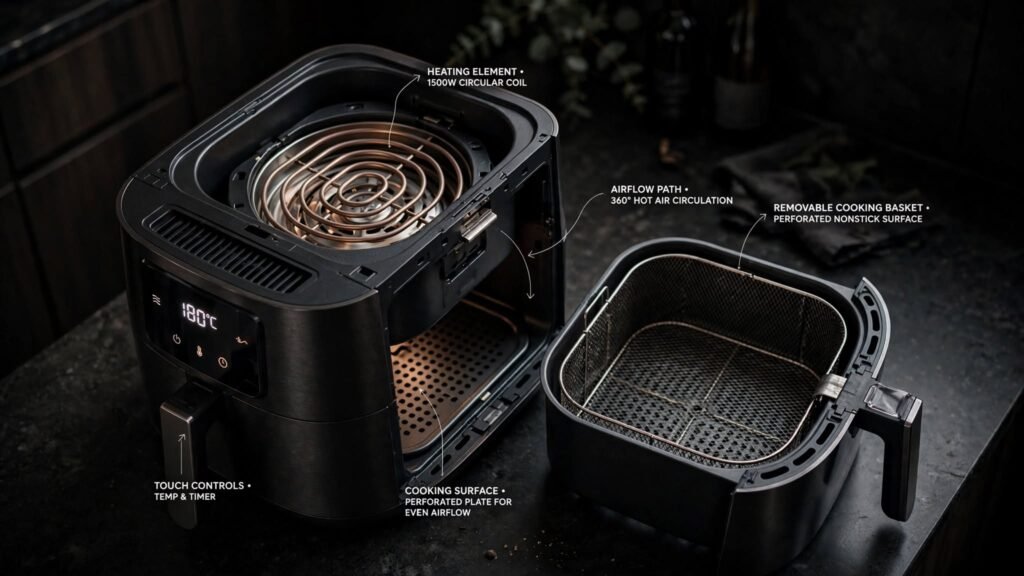
Basket Capacity
Choose a capacity that matches the amount of food you normally cook.
A powerful air fryer isn’t particularly useful if its basket is too small for your usual meals.
Cooking Surface
Basket shape can affect how easily food can be spread out.
A wider surface can be useful for foods that benefit from being arranged in a single layer.
Airflow
Airflow is central to air frying.
A crowded basket can restrict air circulation and affect browning and crisping.
Temperature Control
Look for useful temperature adjustment rather than focusing only on the maximum temperature.
Different foods require different cooking temperatures.
Ease of Cleaning
Check whether the basket and removable parts are easy to clean.
An appliance that is difficult to maintain can become frustrating even if its cooking specifications look impressive.
Preset Programs
Presets can be convenient, but don’t make them your main buying criterion.
Heating performance, airflow, capacity, and temperature control are more fundamental.
Does Higher Wattage Make an Air Fryer Cook Faster?
It can help, but wattage alone doesn’t determine cooking speed.
Cooking time also depends on:
- Food quantity
- Starting temperature
- Food thickness
- Basket size
- Airflow
- Heating design
- Cooking temperature
A higher-wattage model may recover heat more quickly in some situations, particularly after cold food is added, but you shouldn’t assume that an 1,800-watt air fryer will always cook faster than a 1,500-watt model.
Use the manufacturer’s cooking instructions as your starting point.
Does Higher Wattage Make Food Crispier?
No, not by itself.
Crispiness depends on several factors, particularly:
- Air circulation
- Food moisture
- Basket crowding
- Cooking temperature
- Cooking time
- Food surface area
If fries or other foods aren’t getting crispy, buying a higher-wattage appliance isn’t necessarily the first solution.
Check the cooking arrangement and airflow before blaming the wattage.
How Do You Find Your Air Fryer’s Wattage?
You can usually find the wattage on:
- The appliance’s rating label
- The bottom or back of the unit
- The user manual
- The original packaging
- The manufacturer’s product page
Look for a number followed by W, such as 1,200W, 1,500W, or 1,800W.
If you’re comparing models, use the manufacturer’s published specification rather than relying on a retailer’s incomplete listing.
Simple Air Fryer Wattage Buying Guide
If you want the short version:
| Your Situation | Wattage to Consider |
|---|---|
| Mainly cook for yourself | 1,000–1,300W |
| Cook for two | 1,200–1,500W |
| Regular family meals | 1,400–1,700W |
| Large portions and batches | 1,600–1,800W+ |
| Large-capacity/multi-basket cooking | 1,700–2,000W+ |
For many households, 1,400 to 1,700 watts is a sensible middle ground.
If you cook small portions, there’s no need to chase a very high wattage.
If you regularly prepare large batches, look at higher-wattage models, but make sure their capacity and airflow are appropriate too.
Frequently Asked Questions
What is the best wattage for an air fryer?
For many households, 1,400 to 1,700 watts is a practical range. Smaller models can use less, while larger-capacity models may use more.
Is 1,200 watts enough for an air fryer?
Yes. A 1,200-watt model can be suitable for one person, small portions, snacks, and reheating.
Is 1,500 watts good for an air fryer?
Yes. 1,500 watts is a practical middle-ground rating for many household air fryers. Capacity and airflow should still be considered.
Is 1,800 watts too much for an air fryer?
No. An 1,800-watt model can make sense for larger-capacity appliances and heavier cooking loads. Your electrical setup should also be appropriate for the appliance.
Does higher wattage make an air fryer cook faster?
It can help with heating and heat recovery, but cooking speed also depends on food quantity, airflow, temperature, food thickness, and appliance design.
Does higher wattage mean crispier food?
No. Crispiness depends on airflow, moisture, food quantity, cooking temperature, and cooking time as well as wattage.
Does a higher-wattage air fryer use more electricity?
It draws more electrical power at the same operating level and for the same amount of time. Total energy consumption also depends on how long it runs.
What wattage air fryer is best for a family?
For a typical family, around 1,500 to 1,800 watts can be a reasonable range, provided the basket is appropriately sized.
How do I find my air fryer’s wattage?
Check the rating label, user manual, packaging, or manufacturer’s specifications. The rating is normally shown in watts, written as W.
Should I buy the air fryer with the highest wattage?
No.
Choose wattage according to your capacity, food quantity, cooking habits, airflow needs, and electrical setup.
Final Takeaway
So, how many watts should an air fryer have?
For many households, 1,400 to 1,700 watts is a practical range to consider.
A compact 1,000 to 1,300-watt model can work well for one person or light cooking, while larger households and frequent batch cooks may prefer 1,600 to 1,800 watts or more.
But wattage shouldn’t be the only number you compare.
The better approach is to match wattage with capacity, then consider airflow, basket design, temperature control, cooking surface, and the amount of food you normally prepare.
If you want to understand why these factors matter, our guide on How Does an Air Fryer Work? explains how the heating element and circulating hot air work together during cooking.