How Does an Air Fryer Work? Hot Air, Fan & Crisping Explained
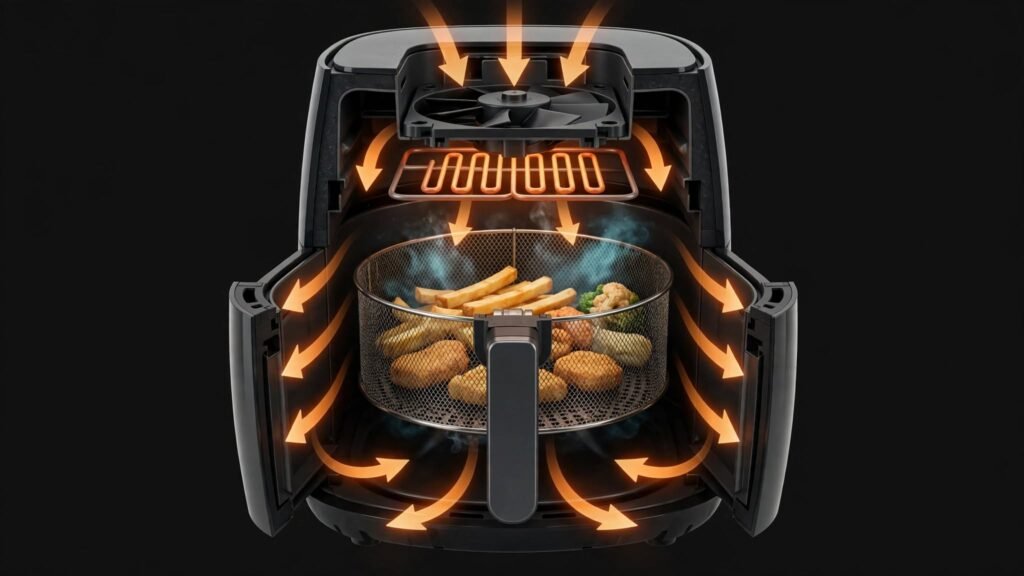
An air fryer cooks food by combining heat, rapid air circulation, and surface moisture loss. A heating element creates heat, a fan moves the heated air around the cooking chamber, and the basket allows that air to reach the food from multiple directions.
As the food heats, moisture leaves its surface. Once the surface becomes hot and dry enough, browning can develop, producing the crisp exterior associated with air-fried food.
That sounds simple, but the details explain why an air fryer can crisp fries, brown chicken wings, roast vegetables, and reheat pizza without immersing the food in a large amount of oil.
If you want the basic definition first, see our What Is an Air Fryer guide. This article goes one step further and explains what is actually happening inside the appliance while it cooks.
How Does an Air Fryer Work?
An air fryer uses a heating element and fan to create a compact convection-cooking environment.
The heating element supplies the heat. The fan circulates that heated air around the cooking chamber and food. The basket or crisper tray is designed to leave openings around the food so moving air can contact more of its surface.
As cooking continues:
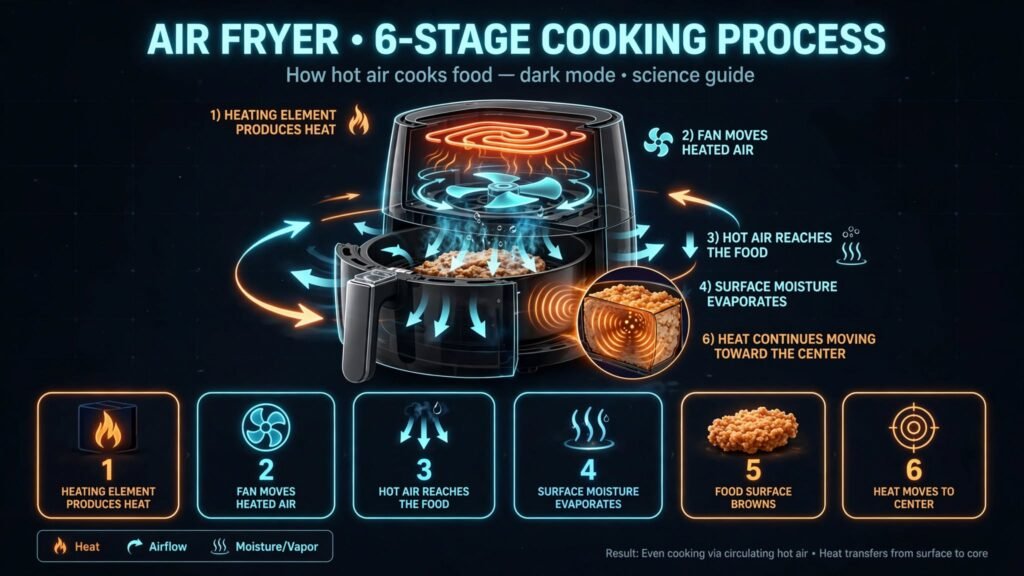
- The heating element produces heat.
- The fan moves heated air through the cooking chamber.
- Heat transfers from the air to the food’s surface.
- Moisture begins leaving the surface.
- The exposed surface becomes hotter and drier.
- Browning reactions develop.
- Heat gradually moves toward the center of the food.
This is the basic mechanism behind air frying.
It is also why an air fryer is not technically frying food in the traditional sense. Deep frying uses hot oil as the primary heat-transfer medium. An air fryer primarily uses moving hot air.
Consumer Reports describes air fryers as essentially compact convection ovens, with the small cooking chamber and concentrated airflow helping produce a crisp exterior efficiently.
What Happens Inside an Air Fryer During Cooking?
The cooking process becomes easier to understand when you follow what happens from the moment the appliance starts.
1. The Heating Element Produces Heat
The first job belongs to the heating element.
When the air fryer operates, the heating system generates the heat needed to raise the temperature inside the cooking chamber.
The exact heating-element design varies by model, so not every air fryer distributes heat in precisely the same way.
But the basic principle remains the same: the appliance needs a source of heat before the fan can circulate heated air around the food.
2. The Fan Moves the Heated Air
The fan is what gives an air fryer its characteristic cooking environment.
Instead of allowing hot air to remain relatively still, the fan continuously moves it through the cooking chamber.
That moving air does two important jobs:
- transfers heat toward the food
- helps carry moisture away from the food’s surface
Airflow therefore affects much more than cooking speed. It can influence how evenly food cooks and how effectively its surface dries and browns.
Some newer air fryers even provide different airflow settings, showing how important air movement can be to the cooking process.
3. Hot Air Reaches the Food
The cooking basket is not simply a container for holding food.
Its openings allow heated air to move around exposed surfaces.
This is one reason basket design matters. Food sitting in a perforated basket has more opportunity to interact with circulating air than food packed tightly against a solid surface.
The exact airflow pattern depends on the appliance.
That means two air fryers set to the same temperature can still produce somewhat different results.
4. Moisture Begins Leaving the Surface
Food contains water, and heating causes moisture at the surface to evaporate.
The moving air helps carry that moisture away.
This matters because a wet surface is less likely to become deeply browned and crisp while significant moisture remains there.
That is why patting certain foods dry before air frying can improve browning. Consumer Reports also recommends drying foods such as meat, fish, and vegetables when a crisp or browned surface is the goal.
5. The Surface Becomes Hot Enough to Brown
As surface moisture decreases, the outside of the food can become hot enough for browning reactions to occur.
One important process is the Maillard reaction, a group of chemical reactions involving amino acids and reducing sugars that contributes to the color and flavors associated with browned foods.
The Maillard reaction is influenced by factors including temperature and moisture, so the surface conditions created during air frying matter.
This helps explain why chicken skin can turn golden brown and why breaded foods can develop a deeper color.
But browning and crispiness are not exactly the same thing.
6. Heat Continues Moving Toward the Center
The outside of food is exposed directly to the hot cooking environment, but the center is heated progressively.
Heat moves inward through the food by conduction.
This is why the outside of a thick chicken breast may look browned before the center has finished cooking.
For foods where internal temperature determines safety, appearance is not enough. The USDA recommends using a food thermometer, and poultry should reach 165°F (74°C) internally.
The Main Parts of an Air Fryer
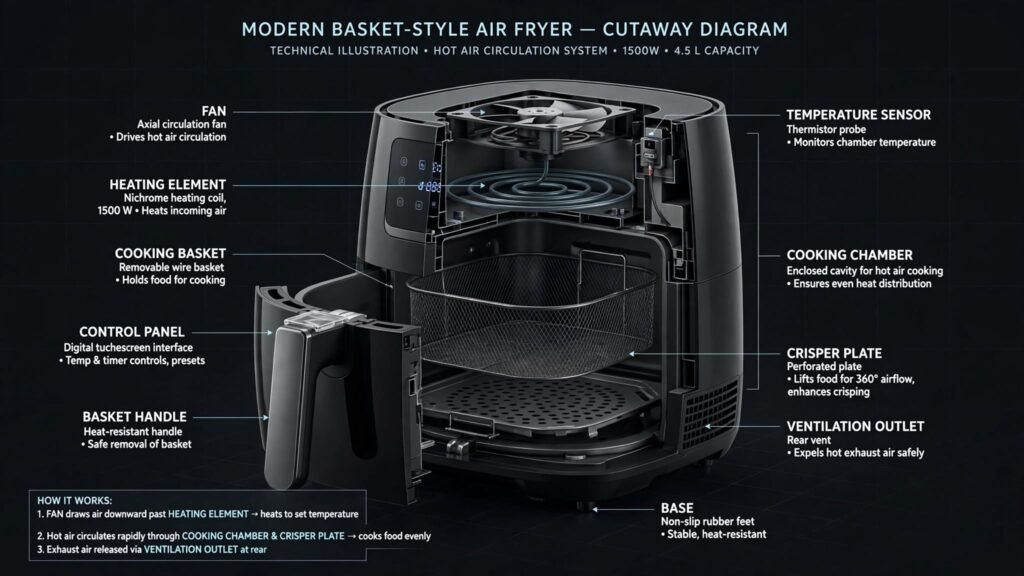
You do not need to understand every component inside your air fryer, but knowing the main parts makes the cooking process easier to understand.
| Part | Main function |
|---|---|
| Heating element | Generates heat |
| Fan | Circulates heated air |
| Cooking basket | Holds food while allowing airflow |
| Crisper plate | Raises food and can improve airflow underneath |
| Cooking chamber | Contains the heated cooking environment |
| Temperature controls | Set the target cooking temperature |
| Timer | Controls the cooking period |
| Vent | Allows air and moisture to leave |
The heating element and fan are the core of the system, but the basket plays an important supporting role.
A basket that gives food plenty of exposed surface area can create a different result from a crowded basket where pieces are pressed against each other.
How Does Hot Air Cook Food?
Air frying is primarily a form of convection cooking, but more than one type of heat transfer can occur inside the appliance.
Convection
Convection is the most obvious part of air frying.
The fan moves heated air around the food. That air transfers heat to the food’s surface while helping remove moisture.
The strength and direction of airflow vary between models, which is one reason air fryers do not all cook identically.
Conduction
Once heat reaches the outside of the food, it travels inward through the food by conduction.
Direct contact also matters.
For example, the part of a food touching a hot crisper plate can receive heat through that contact.
This helps explain why the bottom of a food can brown differently from its top.
Radiation
The heating element can also transfer heat through thermal radiation.
You do not need to calculate radiation to operate an air fryer, but it is another part of the overall cooking environment.
So air frying is not simply “hot air blowing on food.” It is a combination of convection, conduction, and thermal radiation, with convection playing the central role.
Why Does an Air Fryer Make Food Crispy?
The short answer is surface moisture plus heat plus airflow.
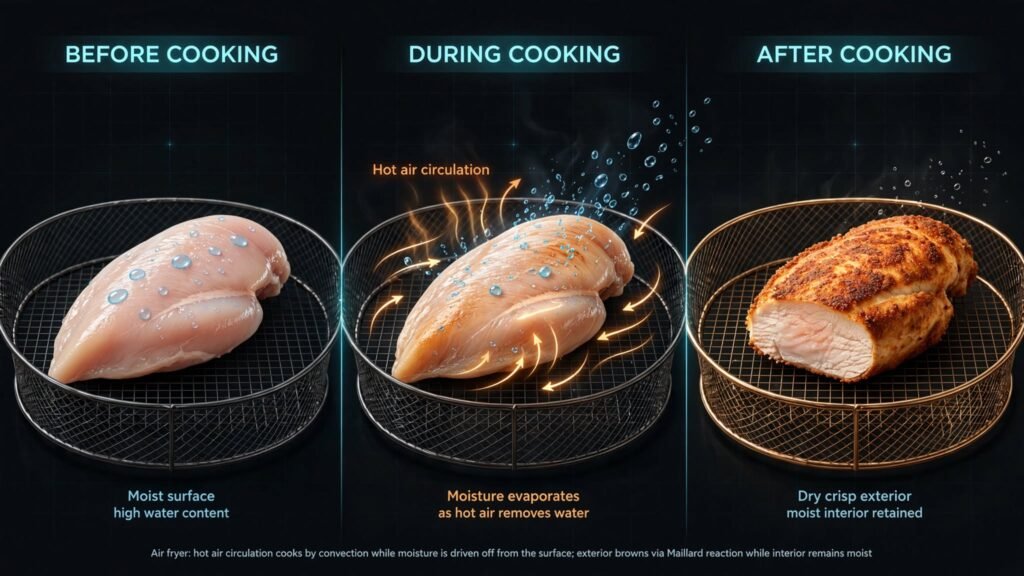
When food enters the air fryer, its surface usually contains some moisture.
As hot air moves over the surface, moisture evaporates.
Once enough moisture has been removed, the surface can become hotter and browning can develop.
This creates the conditions associated with a crisp exterior.
Foods such as:
- French fries
- potato wedges
- chicken wings
- breaded fish
- nuggets
- roasted vegetables
can respond particularly well because their surfaces can dry and brown during cooking.
But the air fryer does not magically make every food crispy.
A food’s moisture content, structure, coating, thickness, amount of oil, temperature, cooking time, and exposure to airflow all matter.
What Role Does Oil Play?
Oil is useful in air frying, but it is not the main cooking medium.
That distinction separates air frying from deep frying.
In a deep fryer, food is surrounded by hot oil. In an air fryer, the main cooking environment is heated air.
A small amount of oil can still help with:
- surface browning
- crispness
- seasoning adhesion
- texture
- some breaded foods
Adding more oil is not automatically the solution when food is not crispy.
If the real problem is overcrowding or excess surface moisture, additional oil may do little to solve it.
For practical guidance on using the appliance itself, see How to Use an Air Fryer.
What Is the Maillard Reaction?
The Maillard reaction helps explain why cooked food develops a browned color and deeper roasted flavors.
It occurs when certain amino acids and reducing sugars react under suitable conditions.
During air frying, the food’s surface can become hot enough for these reactions to occur as surface moisture decreases.
This contributes to the browned appearance of foods such as chicken wings, roasted vegetables, and breaded foods.
However, it is inaccurate to say that the Maillard reaction alone makes food crispy.
Crispness also depends on:
- moisture loss
- food structure
- coating
- temperature
- airflow
- cooking time
The Maillard reaction is one part of the process, not the entire explanation.
Does an Air Fryer Actually Fry Food?
Not in the traditional sense.
Deep frying and air frying use fundamentally different cooking environments.
Deep frying
- Food is surrounded by hot oil.
- Oil is the primary heat-transfer medium.
- A substantial amount of oil is used.
- The food develops the characteristic texture of immersion frying.
Air frying
- Food is surrounded by rapidly moving hot air.
- Little or no added oil may be needed, depending on the food.
- Surface moisture is driven away.
- Browning develops on exposed surfaces.
The finished texture can resemble fried food, but the cooking process is different.
That distinction is useful because it prevents unrealistic expectations. An air fryer can create excellent crispness, but it does not reproduce every characteristic of food submerged in hot oil.
Why Does an Air Fryer Use Less Oil?
An air fryer does not rely on a large oil bath to transfer heat.
Instead, heated air supplies most of the cooking environment.
That is why many foods can be prepared with little or no additional oil.
This does not mean every air-fried food is automatically healthier.
The nutritional quality of the meal still depends on the food, ingredients, preparation, and portion.
The important mechanical difference is simply that oil is not required as the primary heat-transfer medium.
Why Does Airflow Matter So Much?
Airflow is one of the most important parts of the air-frying process.
The fan continuously moves hot air across the food.
That helps with both:
Heat transfer:
Hot air brings heat toward the food.
Moisture removal:
Moving air helps carry evaporated moisture away from the surface.
That combination is particularly useful when the goal is browning and crisping.
This is also why basket design matters. Manufacturers use different basket shapes, perforations, and airflow systems to move hot air around the cooking chamber.
Why Does Overcrowding Make Food Soggy?
Overcrowding works against the basic mechanism of air frying.
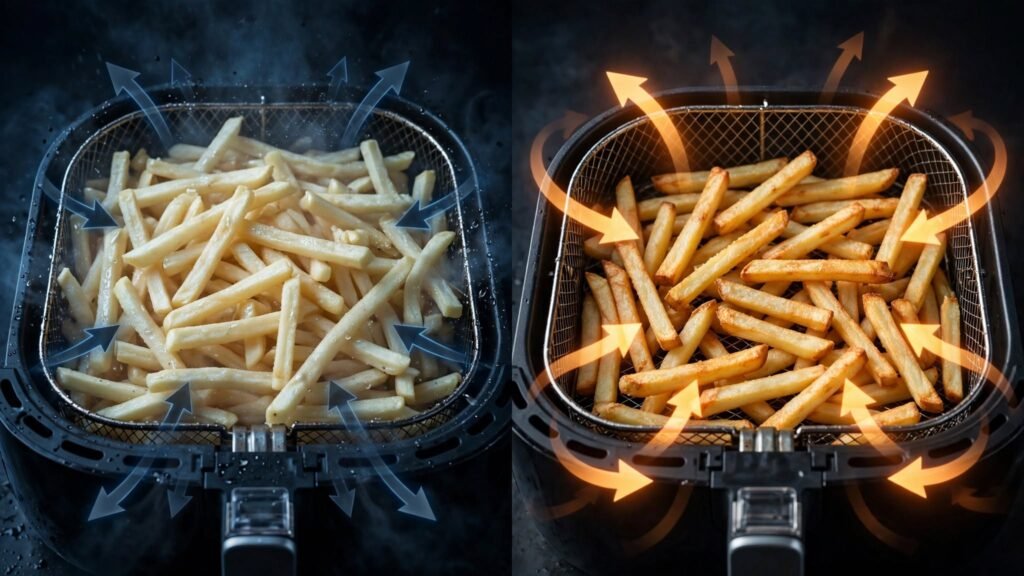
When too much food is packed into the basket:
- pieces touch one another
- less surface is exposed to moving air
- moisture has more difficulty escaping
- airflow becomes less effective around the food
- browning can become uneven
The result can be food that is cooked but soft rather than crisp.
Consumer Reports specifically warns that overfilling the basket can restrict airflow and lead to uneven or soggy results.
A simple example
Imagine a basket filled with a large pile of wet fries.
The fries release moisture while cooking. If they are packed tightly together, that moisture has less opportunity to escape from the surfaces touching neighboring pieces.
Spread the fries out more, and the circulating hot air has better access to them.
That is why cooking in batches can produce better results than simply adding more cooking time.
Air Fryer vs. Convection Oven vs. Deep Fryer
Air fryers and convection ovens share the same broad principle of circulating heated air, but their cooking environments are different.
| Feature | Air Fryer | Convection Oven | Deep Fryer |
|---|---|---|---|
| Main heat-transfer method | Moving hot air | Moving hot air | Hot oil |
| Fan | Usually localized around compact chamber | Circulates oven air | Not primary cooking mechanism |
| Oil bath | No | No | Yes |
| Cooking space | Compact | Larger | Compact |
| Crisping | Often very effective for small portions | Depends on food and oven | Characteristic fried texture |
| Best suited for | Small portions and crisping | Larger meals and multiple dishes | Traditional deep-frying |
Calling an air fryer a small convection oven is a useful starting point, but it does not mean every air fryer and convection oven will cook identically.
Chamber size, airflow, food distance from the heating element, basket design, and food arrangement all affect the result. Consumer Reports and Serious Eats both describe the relationship between air fryers and convection cooking while noting the importance of the compact cooking environment and airflow.
Why Can Two Air Fryers Cook the Same Food Differently?
Temperature is only one part of the cooking equation.
Two appliances can both display 400°F and still produce somewhat different results.
Factors include:
Food quantity
A large batch releases more moisture and gives the circulating air more work to do.
Food thickness
Heat takes longer to reach the center of a thick piece than a thin piece.
Surface moisture
Wet food generally needs more time for its surface to dry and brown.
Airflow
The strength and direction of airflow affect how efficiently heat reaches the food and moisture leaves the surface.
Basket design
Basket shape, perforations, depth, and crisper plates affect how air moves around the food.
Temperature
Higher heat can accelerate browning, but it can also darken an exterior before the center is fully cooked.
Cooking time
Longer cooking generally means greater moisture loss. Too much time can turn a crisp exterior into a dry interior.
Food arrangement
A relatively open arrangement usually gives circulating air better access to the exposed surfaces.
Coatings and sauces
Breading, marinades, sauces, and oil can all change how the food surface responds to heat.
This is why there is no single temperature or cooking time that works perfectly for every air fryer.
Why Is Air-Fried Food Sometimes Soggy?
When food comes out soft instead of crisp, the first thing to investigate is airflow and surface moisture, not necessarily temperature.
Common causes include:
- overcrowding
- wet food
- pieces touching too closely
- insufficient cooking time
- a food that naturally contains a lot of moisture
- an unsuitable coating
A useful troubleshooting sequence is:
- Reduce the batch size.
- Give the food more space.
- Pat suitable foods dry before cooking.
- Shake or turn the food when appropriate.
- Check whether the cooking time is sufficient.
- Only then consider changing the temperature.
This approach addresses the actual cooking process instead of simply turning the heat higher.
Why Can Air-Fried Food Become Dry?
The same mechanism that creates crispness can eventually work against you.
Hot air removes surface moisture. If food stays exposed to heat for too long, more moisture can be lost from the food itself.
This is particularly noticeable with lean foods such as chicken breast.
Higher heat can also accelerate browning and moisture loss.
USDA guidance notes that higher cooking temperatures and longer cooking can increase moisture loss in meat and poultry.
So if food is dry, the solution is not automatically more heat.
Often the better question is whether the food was cooked for too long or whether the chosen temperature was too aggressive for its size and composition.
Does an Air Fryer Cook Food From All Sides?
Hot air can reach multiple exposed surfaces, but not necessarily every surface equally.
The exact airflow depends on the design of the air fryer and how the food is arranged.
Food touching the basket or another piece of food will receive a different amount of direct airflow than an exposed surface.
That is why some foods benefit from shaking, turning, or rearranging during cooking.
The goal is not to make every surface receive exactly the same amount of heat. It is to give the circulating air reasonable access to the food.
What Happens When You Change the Amount of Food?
Changing the batch size can change the cooking environment.
A small amount of food leaves more space for air circulation.
A crowded batch can release more moisture into the chamber while simultaneously restricting airflow around individual pieces.
That means simply doubling the amount of food does not necessarily mean you should double the cooking time.
You may instead need to cook in batches.
This is one of the most important practical consequences of understanding how an air fryer works.
Why Does Food Brown Before the Center Is Done?
The outside and inside of food experience different conditions.
The surface is directly exposed to hot moving air and can dry and brown relatively quickly.
The center receives heat more gradually through conduction.
That creates the possibility of a browned exterior with an undercooked interior, especially when cooking thick foods.
For meat and poultry, always use internal temperature rather than surface color alone to determine whether the food is safely cooked. USDA guidance lists 165°F (74°C) for poultry, while other meats have different safe-temperature requirements.
How Does an Air Fryer Compare With an Oven Recipe?
An oven recipe cannot always be transferred to an air fryer using exactly the same temperature and cooking time.
The cooking chamber is smaller, airflow is different, and food is often closer to the heating element.
For that reason, oven-to-air-fryer adjustments are best treated as starting points rather than guarantees.
For the actual temperature and time conversion process, see our Oven to Air Fryer Conversion guide.
That article handles the conversion question separately so this guide can stay focused on the underlying cooking mechanism.
What Can an Air Fryer Cook?
Understanding the mechanism helps explain why some foods work particularly well.
Air fryers are commonly used for:
- French fries
- potato wedges
- chicken wings
- chicken pieces
- breaded fish
- frozen snacks
- vegetables
- reheated pizza
- roasted foods
- some baked dishes
Foods that benefit from surface browning and dry heat tend to be particularly suitable.
But ingredients behave differently.
A frozen breaded snack may brown quickly because its coating is designed for crisping.
A fresh vegetable contains more water and may need different treatment.
A lean chicken breast can become dry if it stays in the hot airflow too long.
The air fryer provides the cooking environment, but the food itself still determines much of the final result.
Common Air-Fryer Problems Explained by the Cooking Process
| Problem | Likely cause | What to check |
|---|---|---|
| Food is soggy | Crowding or excess surface moisture | Reduce the batch and improve airflow |
| Food is dry | Too much time or heat | Check earlier and consider food thickness |
| Uneven browning | Poor arrangement or airflow | Shake, turn, or rearrange |
| Outside burns too quickly | Excessive heat or thin food | Lower temperature or shorten cooking |
| Food is not crispy | Moisture or restricted airflow | Dry suitable foods and avoid crowding |
| Excessive smoke | Grease, residue, or fatty food | Clean the appliance and check the food |
| Cooking takes longer than expected | Large batch or different appliance airflow | Check quantity, thickness, and basket arrangement |
The advantage of understanding the mechanism is that you can diagnose the problem instead of guessing.
Does Preheating Change How an Air Fryer Works?
Preheating does not change the fundamental mechanism.
The heating element still produces heat, and the fan still circulates it.
The difference is the starting condition.
With a preheated air fryer, the cooking chamber has already reached its intended operating environment before the food goes in.
Whether preheating is necessary depends on the model and recipe. Some air fryers and recipes are designed to start cooking immediately, while others benefit from preheating.
The important point is that preheating is a cooking procedure, not a different cooking technology.
How to Get Better Results Once You Understand the Mechanism
You do not need dozens of tricks.
A few principles cover most situations:
Give food enough space
Air needs room to circulate.
Reduce surface moisture when appropriate
Pat suitable foods dry before cooking when crispness is the goal.
Don’t assume more oil means more crispness
Oil can help, but airflow and moisture control matter too.
Don’t automatically increase the temperature
If food is soggy because of overcrowding, more heat may not fix the underlying problem.
Watch thick foods carefully
The surface can brown before the center is fully cooked.
Shake or turn when appropriate
Redistributing food can improve exposure to circulating air.
Use a thermometer for foods where safety depends on internal temperature
Color and cooking time are not reliable substitutes for internal temperature.
Treat cooking charts as starting points
Different appliances, quantities, thicknesses, and food conditions can produce different results.
These principles are more useful than memorizing one universal air-fryer setting.
Frequently Asked Questions
How does an air fryer work?
An air fryer uses a heating element to produce heat and a fan to circulate that heated air around food. The moving hot air transfers heat to the food while helping remove surface moisture, allowing browning and crisping to develop.
Is an air fryer just a convection oven?
An air fryer uses convection cooking, so the basic principle is similar to a convection oven. However, its compact chamber, airflow pattern, basket design, and proximity between the food and heating system can produce different results.
Does an air fryer need oil?
Not necessarily. Many foods can be cooked with little or no added oil. A small amount can help with browning, crisping, or seasoning adhesion for certain foods.
Why does an air fryer make food crispy?
The moving hot air helps remove moisture from the food’s surface. As the surface becomes drier and hotter, browning can develop and the exterior can become crisp.
Why does overcrowding make food soggy?
Crowding reduces airflow around individual pieces and can trap moisture near their surfaces. Cooking smaller batches gives hot air better access to the food.
Does an air fryer cook faster than an oven?
It often can, particularly for small portions, because the cooking chamber is compact and the airflow is concentrated. However, cooking time varies according to the food, quantity, thickness, temperature, and appliance.
Why is my air fryer food dry?
Food can become dry when it is exposed to heat for too long, cooked at an unsuitable temperature, or naturally has little moisture. Thickness also matters because smaller pieces can overcook more quickly.
Why isn’t my air fryer food crispy?
Check the amount of food first. Overcrowding can restrict airflow. Also consider surface moisture, cooking time, temperature, food arrangement, and whether the food itself is suitable for crisping.
Is air frying the same as deep frying?
No. Deep frying cooks food while it is immersed in hot oil. Air frying primarily uses rapidly moving hot air. The finished texture can be similar in some cases, but the cooking processes are different.
Does an air fryer cook food evenly?
It can cook food quite evenly when the basket is arranged properly, but results depend on airflow, food quantity, basket design, thickness, and whether the food needs to be shaken or turned.
Final Conclusion
An air fryer works through a straightforward combination of heat, airflow, and moisture control.
The heating element creates heat. The fan moves that heated air through the cooking chamber. The basket gives the air access to the food, while the moving air helps carry moisture away from the surface.
As the surface becomes drier and hotter, browning can develop. Heat then continues moving toward the center of the food.
That simple process explains many of the results you see when air frying.
Overcrowding can make food soggy because it restricts airflow. Excessive cooking can make food dry because more moisture is lost. Wet surfaces can delay browning. Shaking or turning can expose more of the food to circulating air.
The answer to a disappointing result therefore isn’t always “turn up the temperature.”
Sometimes the better fix is a smaller batch. Sometimes the food needs to be dried. Sometimes it needs to be turned. And sometimes the cooking time simply needs to be reduced.
Once you understand what the heating element, fan, basket, airflow, and moisture are doing, an air fryer becomes much easier to understand and use.