Can You Put Glass in an Air Fryer? Safety Guide
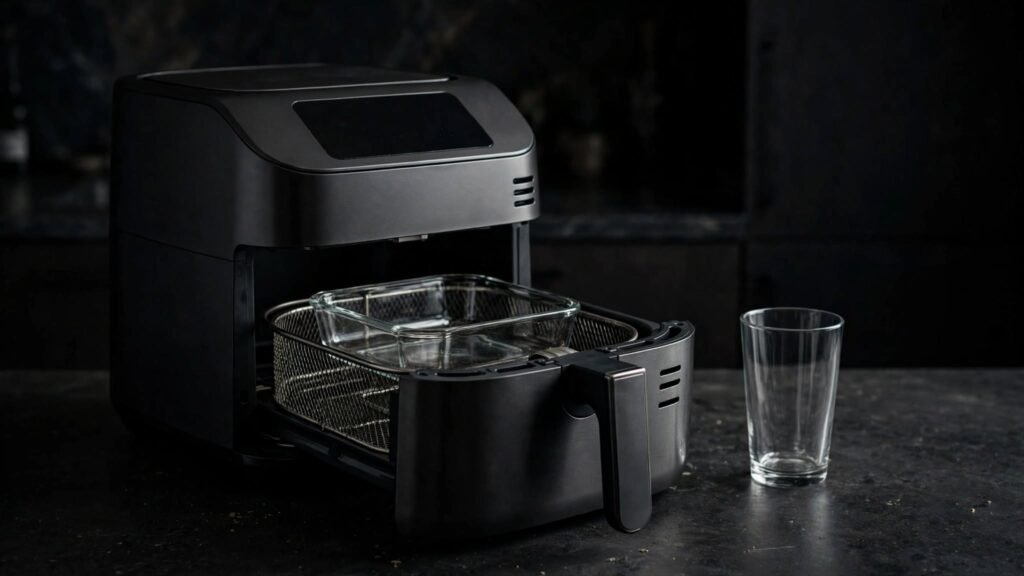
Yes, some glass cookware may be suitable for an air fryer, but you should never assume that any glass dish is safe simply because it fits inside the basket.
The important question is not just whether the glass can handle heat. You also need to consider the manufacturer’s instructions, the cookware’s temperature limits, its condition, sudden temperature changes, and whether the dish interferes with the air fryer’s airflow.
There is also an important exception that is easy to miss: Pyrex’s current U.S. guidance says its glassware should not be used in air fryers.
So if you’re holding a glass bowl and wondering whether it can go into your air fryer, don’t rely on a generic “glass is oven-safe” rule.
Here’s how to make the decision safely.
Can You Put Glass in an Air Fryer?
Only if the specific glass cookware is approved or intended by its manufacturer for that type of use and the air-fryer temperature stays within the cookware’s limits.
Glass cookware varies considerably. A purpose-made baking dish is not the same thing as a drinking glass, decorative bowl, storage container or random glass food container.
Before using glass, check:
- The manufacturer’s instructions
- The maximum temperature rating
- Whether air-fryer or countertop-appliance use is permitted
- Whether the dish is designed for cooking rather than storage or serving
- Whether it has cracks, chips or severe scratches
- Whether it fits without interfering with airflow
If you cannot establish that the glassware is suitable, don’t use it in the air fryer.
There is very little upside to guessing when another suitable cooking container is available.
Is Oven-Safe Glass Automatically Safe in an Air Fryer?
No.
This is one of the biggest points of confusion.
An oven-safe label tells you something about the cookware’s intended use, but it should not automatically be interpreted as approval for every countertop appliance.
The manufacturer’s instructions are more specific than a general label.
For example, Pyrex states that its glassware can be used for cooking and baking in preheated conventional and convection ovens, but its current safety instructions specifically say not to use the glassware in an air fryer or other listed countertop appliances.
So the safe approach is:
Oven-safe does not automatically mean air-fryer-safe.
If the manufacturer specifically excludes air fryers, follow that instruction even if the dish has an oven-safe rating.
Why Can Glass Break in an Air Fryer?
The main concern with glass cookware is thermal stress.
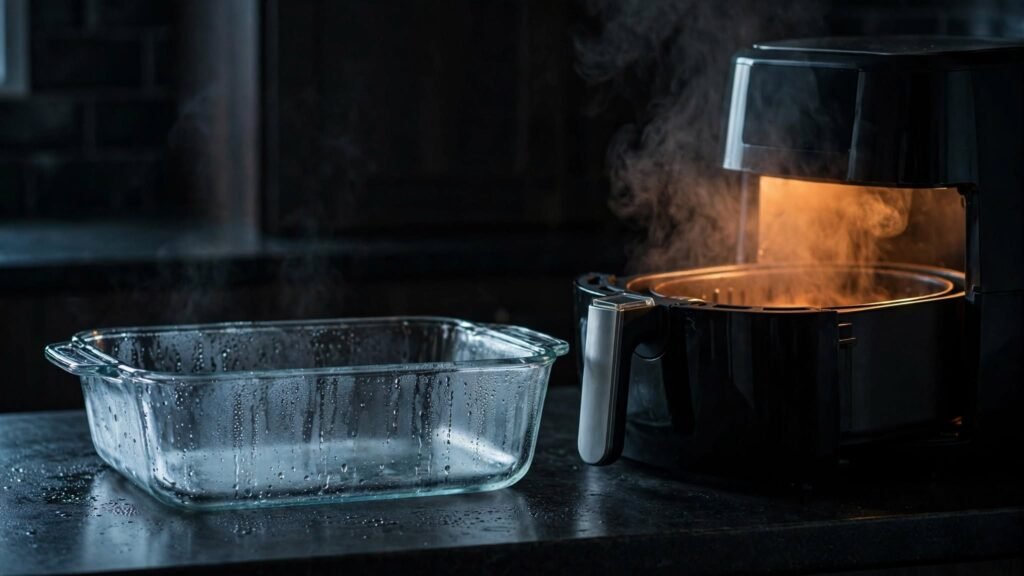
Glass can be damaged when different parts of the material experience rapid temperature changes. A cold dish suddenly exposed to high heat can experience stress as it heats and expands.
The reverse can also be a problem.
For example, placing very hot glass on a cold or wet surface can create a sudden temperature change. Pyrex specifically warns against these situations and recommends allowing hot glassware to cool on an appropriate dry surface.
Damage can also weaken glass.
A chipped, cracked or severely scratched dish should not be used for high-temperature cooking. Pyrex’s safety guidance specifically warns against using damaged glassware because its strength may be compromised.
The simple rule
If the glass is:
- damaged,
- not intended for cooking,
- not rated for the temperature,
- specifically prohibited by its manufacturer, or
- of unknown suitability,
don’t put it in the air fryer.
Can You Put Pyrex in an Air Fryer?
For Pyrex glassware covered by the current U.S. Pyrex safety guidance, no.
This is worth stating clearly because many articles online give a generic “Pyrex is oven-safe” answer.
Pyrex’s official FAQ currently answers the air-fryer question with no, and its safety page says not to use its glassware with countertop appliances including air fryers.
So don’t rely on:
“It’s Pyrex, so it must be safe.”
Instead, follow the manufacturer’s current instructions for the exact product and market you’re using.
For the Pyrex products covered by the cited guidance, the answer is straightforward: use another type of cookware in the air fryer.
Can You Put a Glass Bowl in an Air Fryer?
A glass bowl is not automatically suitable just because it is made of thick glass.
First determine what the bowl was designed for.
A bowl intended for:
- serving,
- food storage,
- decoration, or
- ordinary table use
should not automatically be treated as baking cookware.
Even if a bowl is designed for cooking, you still need to check its manufacturer’s instructions and temperature limits.
Size matters too
A large glass bowl can take up much of the air fryer’s cooking space.
That can reduce the amount of hot air reaching the food and change the way it cooks.
This matters particularly for foods where crisping is important.
For example, putting fries inside a deep container changes the cooking environment compared with spreading those fries directly in the air-fryer basket.
So there are really two separate questions:
- Is the glass cookware safe for the intended temperature and appliance?
- Will its size and shape allow the air fryer to work properly?
Both matter.
What About Tempered Glass?
Tempered glass is specially processed to improve its strength and resistance to certain types of thermal stress.
That can make it useful in cookware.
But “tempered” does not mean “safe for every appliance.”
A tempered-glass product still has specific design limitations and manufacturer instructions.
Therefore, don’t use a tempered-glass bowl in an air fryer merely because the label says “tempered.”
Look for actual cooking instructions and temperature information for that particular product.
What About Borosilicate Glass?
Borosilicate glass is known for good resistance to temperature changes and is used in various heat-resistant products.
But again, the material name isn’t enough.
A product made from borosilicate glass can still have restrictions on how and where it should be used.
Think of it this way:
Borosilicate describes the material. The manufacturer’s instructions describe the product.
When the two pieces of information seem to conflict, follow the product’s actual usage instructions.
Can Cold Glass Go Into a Hot Air Fryer?
It’s best not to put very cold glass directly into a hot air fryer unless the manufacturer specifically says that the cookware is suitable for that situation.
A dish coming directly from a refrigerator or freezer can experience a much more abrupt temperature change than one that has been sitting at room temperature.
Pyrex’s safety guidance specifically warns against transferring its glassware directly from the freezer to a hot oven and advises avoiding sudden temperature changes.
The broader lesson is simple:
Don’t create unnecessary thermal shock.
And if the manufacturer’s instructions give specific preparation or temperature guidance, those instructions take priority.
Does Glass Affect Air Fryer Airflow?
Yes, it can.
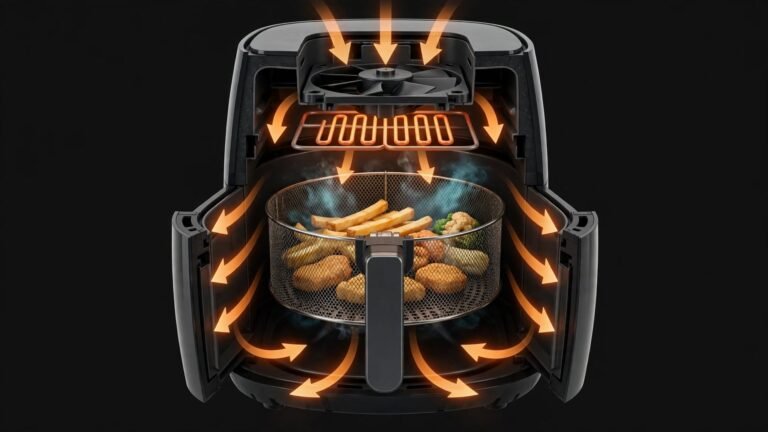
An air fryer relies on circulating hot air around the food.
When you place a large container inside the basket, you change the space available for that airflow.
That can affect:
- browning
- crisping
- cooking speed
- how evenly food cooks
This doesn’t necessarily mean the glass itself is unsafe. It means the cookware can change the way the appliance cooks.
That’s why a container that physically fits inside the basket may still be a poor choice for a particular recipe.
A useful example
A small baking dish may make sense for a contained food such as a casserole.
The same dish would be less useful for fries that need hot air circulating around their surfaces.
The cookware should match the food.
How to Use Approved Glass Cookware Safely
If your manufacturer specifically allows the glass cookware to be used in the appliance, follow these precautions.
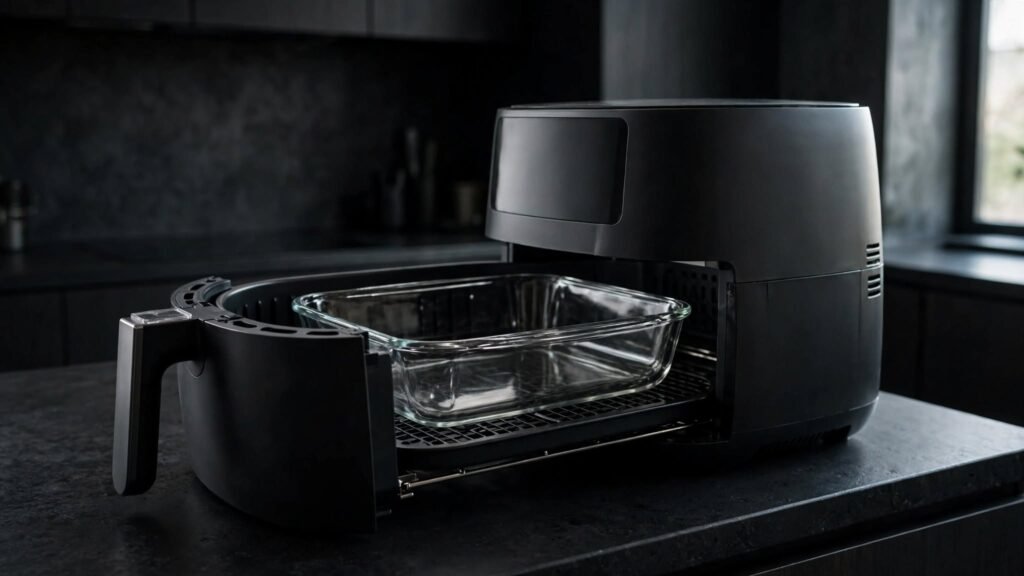
1. Check the temperature limit
Find the cookware’s stated temperature limit.
Then compare it with the temperature you intend to use.
Do not guess.
If the air fryer temperature exceeds the cookware’s stated limit, don’t use that dish.
2. Inspect the glass
Before cooking, check for:
- Cracks
- Chips
- Deep scratches
- Damaged edges
Don’t use damaged glass for high-temperature cooking.
3. Avoid sudden temperature changes
Don’t unnecessarily move very cold glass directly into intense heat.
Likewise, don’t put hot glass onto a cold, wet surface.
Allow it to cool appropriately according to the manufacturer’s instructions. Pyrex specifically warns against placing hot glassware on wet or cool surfaces.
4. Make sure the dish fits properly
The cookware should sit securely.
Don’t force an oversized dish into the basket.
It should not interfere with the drawer, heating area or ventilation.
5. Don’t block the air path
Even approved cookware can change airflow.
Leave sufficient space for the air fryer to operate as intended.
6. Handle hot glass carefully
Glass cookware can become extremely hot.
Use dry heat protection when handling it and place it on an appropriate heat-resistant surface.
What Glass Should You Avoid?
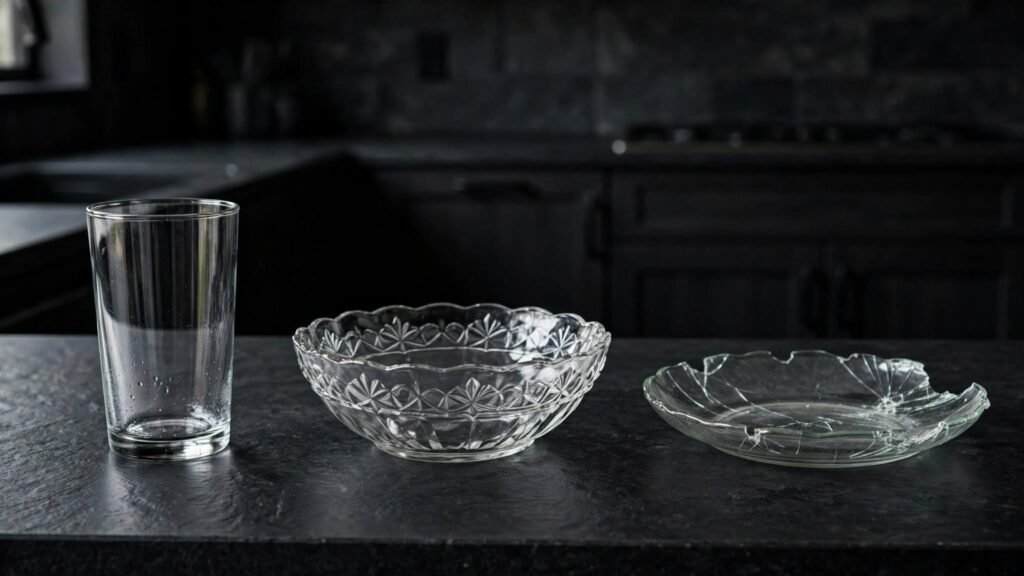
Some choices are easy to eliminate.
Ordinary drinking glasses
A drinking glass is designed for drinking, not automatically for high-temperature cooking.
Thickness alone doesn’t make it suitable.
Decorative glassware
Decorative bowls and serving pieces should not be treated as baking dishes unless the manufacturer specifically says they are suitable for cooking.
Damaged glass
Don’t use chipped, cracked or severely scratched cookware for high-temperature cooking.
Unknown glass containers
If you cannot determine what the container is designed for or what temperatures it can handle, don’t experiment with it.
Storage containers without cooking approval
A container designed for storing leftovers isn’t automatically designed for air-fryer cooking.
Storage and cooking are different uses.
Can You Bake in a Glass Dish in an Air Fryer?
If the specific glass dish is approved for air-fryer use, it can potentially be used for foods that benefit from being contained in a dish.
Examples might include:
- Small baked desserts
- Egg dishes
- Casseroles
- Baked pasta
- Other contained foods
However, the cookware can affect the final result.
A recipe written for a metal pan may brown differently in another material. The shape and depth of the dish can also change how quickly the center cooks.
So don’t assume that a recipe’s original timing will remain identical after changing the cookware.
Check the food rather than blindly following the clock.
Glass vs. Metal vs. Silicone
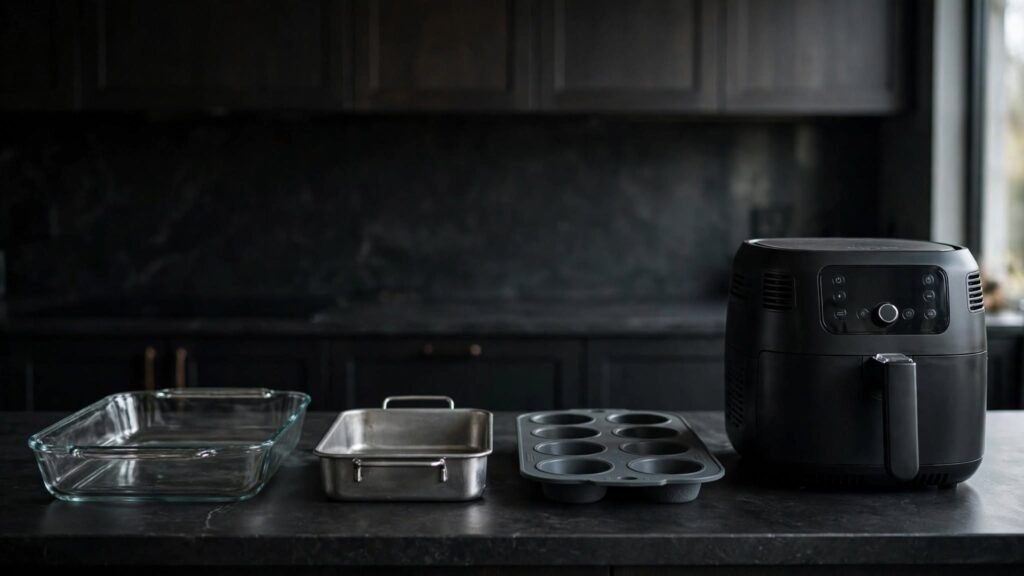
| Cookware | Main advantage | Main concern |
|---|---|---|
| Glass | Useful for some contained baking | Manufacturer restrictions and thermal shock |
| Metal | Good option for many air-fryer baking applications | Can change browning and cooking speed |
| Heat-rated silicone | Flexible and lightweight | Must be rated for the cooking temperature |
The best choice depends on the recipe and the manufacturer’s instructions.
For an air fryer, metal cookware and properly rated silicone are often practical alternatives when glass isn’t approved.
Common Mistakes to Avoid
Mistake 1: “It fits, so it’s safe.”
Physical fit does not prove cookware suitability.
Mistake 2: “It’s oven-safe, so it works everywhere.”
This is not a safe assumption.
Mistake 3: “It’s tempered, so nothing can happen.”
Tempered glass still has limits.
Mistake 4: Using damaged cookware
Cracks and chips are not cosmetic problems when high heat is involved.
Mistake 5: Ignoring the manufacturer’s instructions
A manufacturer’s instructions for a specific product are more useful than a generic internet rule.
Mistake 6: Forgetting about airflow
A dish can fit while still changing the way the air fryer cooks.
A Quick Glass Safety Checklist
Before putting any glass cookware into an air fryer, ask:
| Question | If the answer is “No” |
|---|---|
| Does the manufacturer allow this type of use? | Don’t use it |
| Is the cookware rated for your cooking temperature? | Don’t use it |
| Is the glass free from cracks and chips? | Don’t use it |
| Is it actually designed for cooking? | Don’t use it |
| Does it fit without interfering with airflow? | Choose a smaller/suitable option |
| Can you avoid sudden temperature changes? | Follow the manufacturer’s guidance |
If you’re unsure about even one of the important safety points, choosing another cookware option is the smarter move.
Frequently Asked Questions
Can you put glass in an air fryer?
Some glass cookware may be suitable, but you should follow the manufacturer’s instructions for the specific product. Do not assume that all oven-safe or tempered glass is approved for air-fryer use.
Can I put a glass bowl in an air fryer?
Only if the specific bowl is designed and approved for the intended high-temperature cooking use. A normal drinking, serving or storage bowl should not automatically be used as cookware.
Can you put Pyrex in an air fryer?
For Pyrex glassware covered by its current U.S. safety guidance, no. Pyrex specifically says not to use its glassware in an air fryer.
Can cold glass go into an air fryer?
Avoid putting very cold glass directly into a hot air fryer unless the manufacturer specifically says the product is suitable for that use. Sudden temperature changes can stress glass.
Can glass crack in an air fryer?
Yes. Thermal stress, excessive temperatures, impact damage and existing cracks or chips can contribute to glass breakage.
Is tempered glass safe in an air fryer?
Not automatically. Tempered glass may have greater resistance to thermal stress than ordinary glass, but the specific product still needs to be approved for the intended use and temperature.
Is borosilicate glass safe in an air fryer?
The material itself is not a universal safety guarantee. Check the manufacturer’s instructions for the specific cookware.
Does glass affect air-fryer cooking?
It can. A glass dish changes the way hot air reaches the food and can affect browning, crisping and cooking time.
What can I use instead of glass in an air fryer?
Depending on the recipe, suitable metal cookware or heat-rated silicone cookware may be alternatives. Always check the cookware’s temperature rating and intended use.
Final Conclusion
Can you put glass in an air fryer? Sometimes, but never assume that all glass is suitable.
The safest way to make the decision is to check the specific cookware manufacturer’s instructions, temperature limits and intended use.
Avoid damaged glass, don’t create unnecessary temperature shocks, and don’t use a container that blocks the air fryer’s airflow.
And if you’re considering Pyrex, don’t rely on the common “Pyrex is oven-safe” shortcut. Current Pyrex guidance specifically says its glassware should not be used in air fryers.
When the instructions don’t clearly approve the cookware, use another option. With glass and high heat, guessing is a particularly bad form of recipe improvisation.
If you want to understand why airflow matters so much when using cookware, read our guide on How Does an Air Fryer Work? to see how the appliance circulates hot air around your food.