French Door Air Fryer: What It Is, How It Works, Pros, Cons, and Is It Worth It?
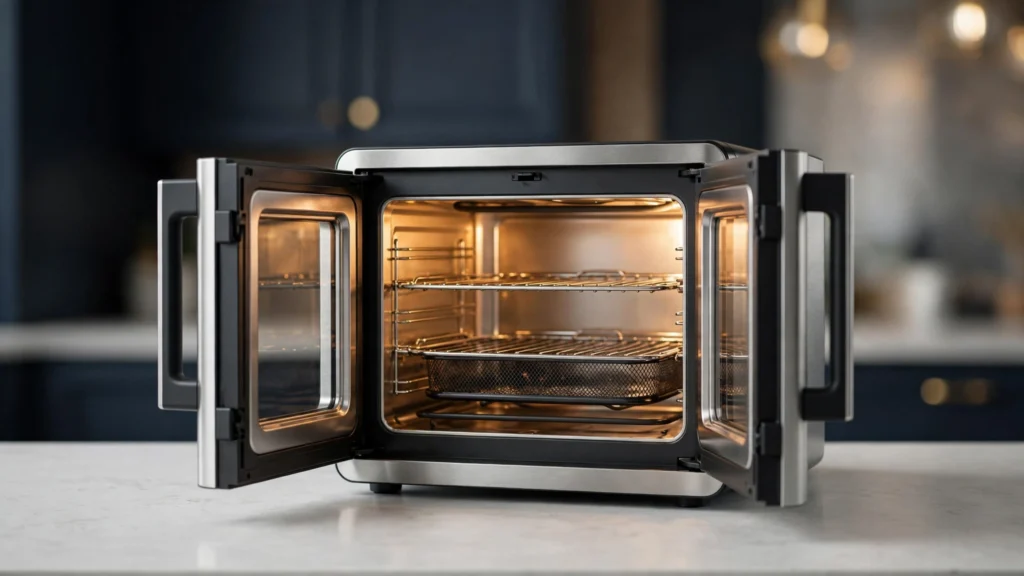
A French door air fryer is an oven-style countertop appliance that uses two doors meeting in the middle instead of the single pull-down door or removable basket found on many other air fryers.
The design is interesting, but the doors are not the main reason to buy one.
What matters more is how much usable cooking space you get, how well air moves around the food, how easy the trays are to access, how much counter space the appliance needs, and whether you actually need its extra cooking functions.
Some French door models combine air frying with baking, roasting, broiling, toasting, reheating, and dehydrating. Current models can therefore behave more like compact countertop ovens than simple basket air fryers.
So before buying one, it helps to understand what the French-door design actually changes, where it helps, and where it doesn’t.
What Is a French Door Air Fryer?
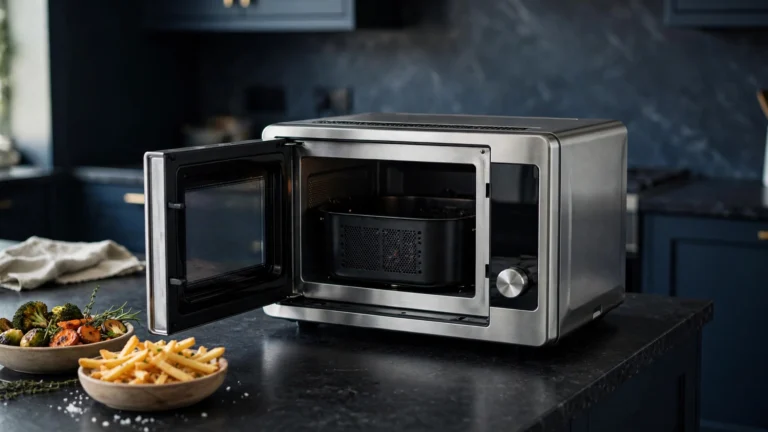
A French door air fryer is generally a countertop oven-style air fryer with two doors that open from the center.
Instead of pulling a basket out toward you, you normally open the front doors and access the cooking chamber, trays, or racks inside.
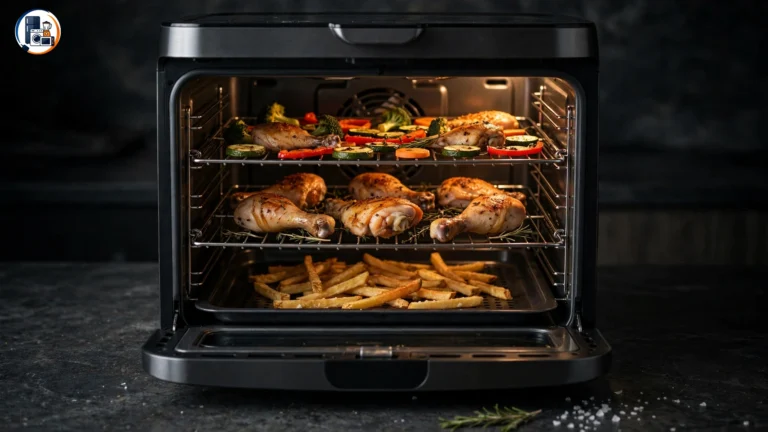
This format gives the appliance a wider cooking area and makes it suitable for foods that can be awkward in a deep basket, such as pizza, toast, vegetables spread across a tray, or larger portions.
Many models also combine several cooking modes in one appliance. For example, the Midea Flexify is marketed with functions including air fry, roast, bake, broil, toast, pizza, reheat, slow cook, dehydrate, and warm.
But there is an important distinction:
French doors are a design feature, not a guarantee of better air-frying performance.
A well-designed basket air fryer can still produce excellent crisping. A poorly designed oven-style air fryer can have uneven airflow or take longer to cook.
That is why you should evaluate the cooking system, not just the door design.
How Does a French Door Air Fryer Work?
The basic idea is similar to other air fryers.
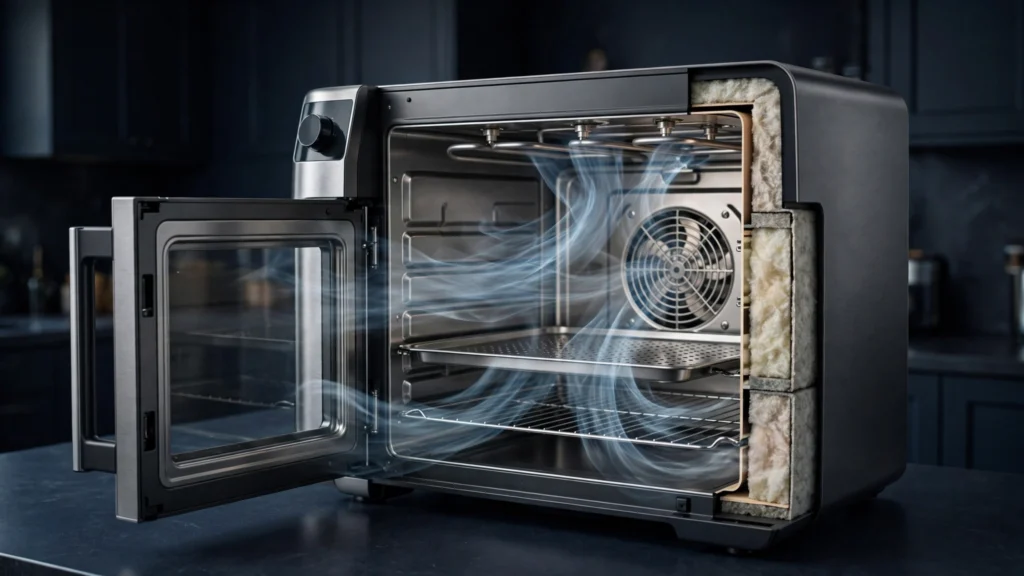
A heating element produces heat while a fan moves hot air around the food.
The combination of heat and moving air helps brown and crisp the exterior of food without requiring the large amount of oil used for traditional deep frying.
In an oven-style design, food normally sits on an air-fry tray, rack, basket, or pan rather than inside a removable drawer.
The exact airflow pattern varies between models.
Some manufacturers use specific convection or air-circulation systems. Midea, for example, describes its Flexify model as using a 360° air cyclone system and temperature control intended to distribute heat across the cooking chamber.
But don’t assume that every French-door model performs the same way.
The important factors are
- Fan strength and airflow
- Heating-element placement
- Distance between food and heating elements
- Rack position
- Air-fry tray design
- Amount of food in the chamber
- Whether food blocks the airflow
- Temperature accuracy
This is why a long list of presets shouldn’t automatically convince you that an appliance will air fry better.
Why Do French Door Air Fryers Have Two Doors?
The two-door design is primarily about access and appliance design.
The doors meet in the center and open outward, giving you access to a wide cooking cavity.
That can make it easier to:
- Insert a large tray
- Remove a baking pan
- Check food
- Access multiple rack levels
- Work with wider foods
Another practical benefit is that the doors don’t use the same downward-opening mechanism as many toaster ovens.
However, the French-door format also creates additional areas that need cleaning, including glass, hinges, and door seams.
So the design gives you convenience in one area while potentially creating extra maintenance in another.
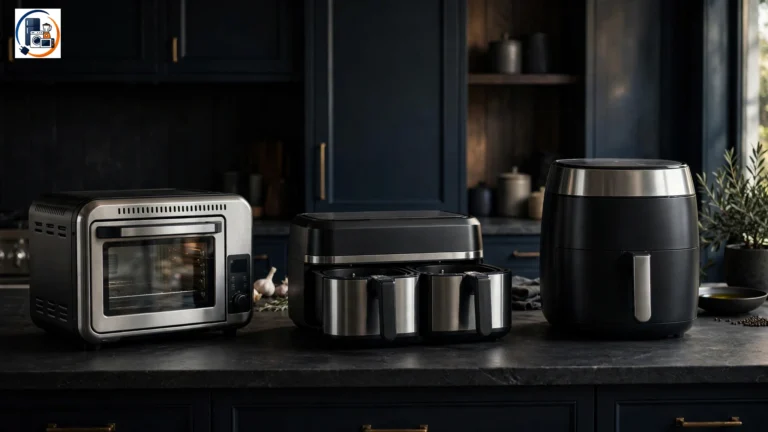
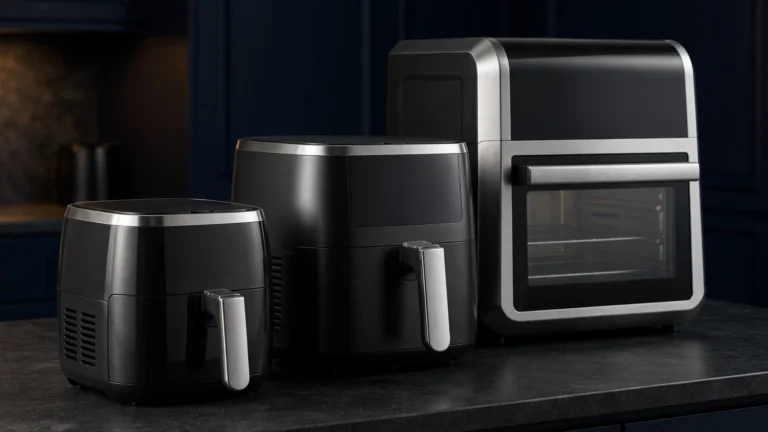
French Door Air Fryer vs. Basket Air Fryer
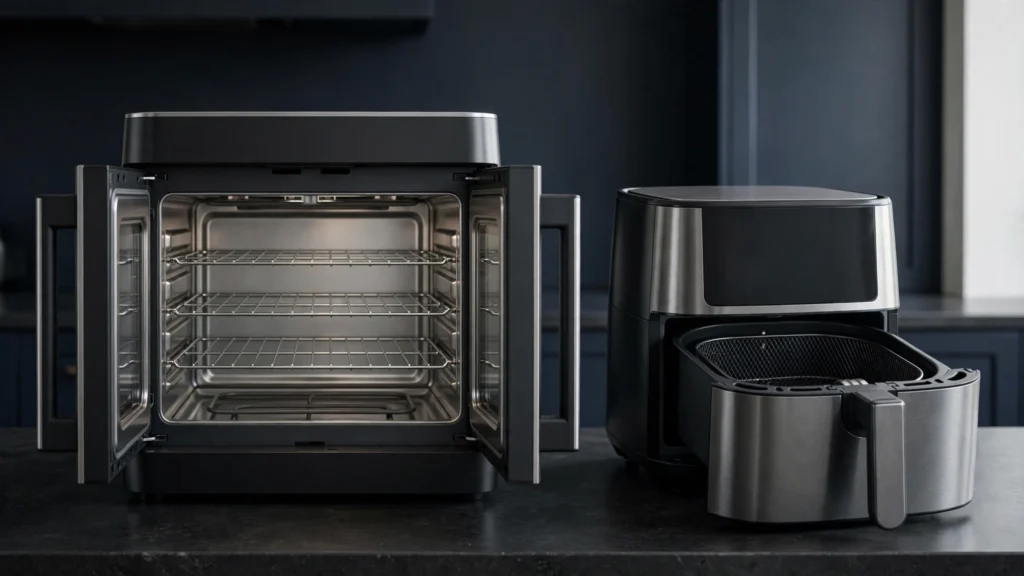
This is probably the most important comparison for someone deciding what type of air fryer to buy.
A basket air fryer is usually designed around quick, concentrated air frying.
A French-door model is generally designed around air frying plus broader countertop-oven functionality.
| Feature | French Door Air Fryer | Basket Air Fryer |
|---|---|---|
| Cooking chamber | Wide oven-style cavity | Drawer/basket |
| Capacity | Usually larger | Usually smaller |
| Large flat foods | More suitable | Can be difficult |
| Small portions | Can be excessive | Usually convenient |
| Air frying | Yes. | Yes. |
| Baking | Often available | Limited depending on model |
| Toasting | Often available | Usually not a primary function |
| Roasting | Usually available | Available on some models |
| Dehydrating | Common on multifunction models | Available on some models |
| Counter space | Usually more | Usually less |
| Food access | Front trays/racks | Pull-out basket |
| Cleaning | More surfaces and accessories | Usually simpler |
| Best fit | Larger meals + multiple cooking functions | Quick everyday air frying |
The key takeaway is simple:
If you mainly want fries, wings, nuggets, and vegetables for one or two people, a basket model may make more sense.
If you want an appliance that can also handle pizza, toast, roasting, baking, and larger tray-based meals, the oven-style format becomes more interesting.
French Door Air Fryer Pros and Cons
Here’s the honest version without pretending the design is perfect.
Pros
| Pros | Why It Matters |
|---|---|
| Larger cooking area | Useful for family-sized portions and flat foods |
| Multiple cooking functions | One appliance can handle air frying, baking, roasting, and more. |
| Easy tray access | Wide doors make the cooking cavity easier to reach. |
| Good for flat foods | Pizza, toast, and tray-based foods can fit more naturally. |
| Multiple rack positions | Can provide more flexibility when cooking different foods |
| Viewing window | Lets you monitor browning without constantly opening the appliance |
| Countertop oven functionality | Can reduce the need for separate small appliances |
| Useful for larger meals | Better suited to foods that don’t fit comfortably in a small basket |
Current models demonstrate this broader countertop-oven approach. For example, the Midea Flexify combines air frying with multiple other cooking modes and a relatively large cooking cavity.
Cons
| Cons | Why It Matters |
|---|---|
| Takes more counter space | The larger body can be difficult in a small kitchen. |
| Usually needs more cleaning | Trays, racks, glass, and the cooking cavity all need attention. |
| Can be excessive for small meals | A large cavity isn’t always convenient for one serving. |
| Performance varies by model. | Door design alone doesn’t guarantee even crisping. |
| May need food rotation | Different rack positions can receive different airflow and heat. |
| More accessories to store | Racks, trays, and baskets need somewhere to go. |
| Can cost more | More functionality often means a larger appliance and higher price. |
| Requires careful countertop planning | Door opening, ventilation, and clearance all matter. |
Current testing also shows why specifications alone aren’t enough. Good Housekeeping found the Midea Flexify performed well for foods such as chicken wings and fries but took longer when cooking larger meats.
What Makes a French Door Air Fryer Good at Air Frying?
This is where many buying guides become too focused on capacity.
Bigger does not automatically mean better.
For air frying, look for these characteristics.
1. Good airflow
Hot air needs room to move around the food.
If the chamber is large but airflow is weak, the appliance may not produce the crisping you expect.
2. A useful air-fryer tray
A perforated tray or basket allows hot air to reach more of the food surface.
3. Practical rack spacing
Multiple rack positions sound impressive, but they only help if there is enough room for food and airflow.
4. Good temperature control
Temperature consistency matters when you’re trying to brown food without burning the outside.
5. Real usable capacity
Ignore capacity numbers alone.
A manufacturer may advertise the total internal volume, but what matters to you is
What can actually fit on the air-fryer tray?
That’s the number worth thinking about.
Are French Door Air Fryers Good for Crispy Food?
They can be.
But the French-door design itself does not create crispiness.
Crisping depends on heat, airflow, food quantity, moisture, tray design, and cooking temperature.
Independent testing of the Midea Flexify, for example, found that it produced mostly crispy and evenly fried foods, while its slower maximum fan speed could affect how quickly it cooked.
This illustrates an important buying lesson:
Don’t buy a French-door air fryer simply because it looks like a larger air fryer. Evaluate how its airflow and cooking surfaces are designed.
Also avoid overcrowding the tray.
If food is packed too tightly together, hot air cannot circulate effectively around every piece.
How Much Food Can You Cook?
This depends heavily on the model.
Some French-door air fryers are designed with large cavities and multiple rack positions. For example, Midea lists its Flexify at 26 QT and positions it as a multifunction countertop appliance.
But advertised capacity is not the same as usable air-frying capacity.
Imagine two appliances:
- Appliance A has a large cavity but a relatively small air-fry basket.
- Appliance B has a slightly smaller cavity but a wide perforated tray.
For air frying, Appliance B could be more useful.
That’s why you should check the actual tray dimensions before buying.
What Can You Cook in a French Door Air Fryer?
Depending on the model and included accessories, you may be able to use one for:
Air frying
- French fries
- Chicken wings
- Nuggets
- Vegetables
- Frozen snacks
- Breaded foods
Baking
- Cookies
- Small cakes
- Pastries
- Bread
Roasting
- Chicken
- Vegetables
- Meat
- Potatoes
Other functions
- Toasting
- Broiling
- Reheating
- Dehydrating
- Pizza
- Warming
Not every model offers all of these functions, so check the actual specifications rather than assuming that every French-door air fryer is a 10-in-1 or similar appliance.
What to Measure Before Buying
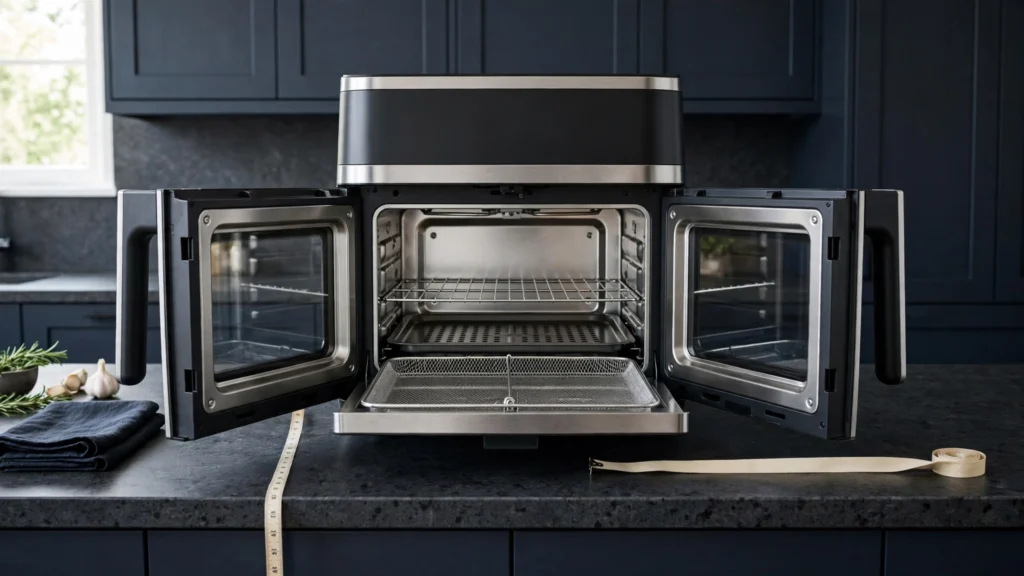
This is one of the most important sections of the entire guide.
Do not buy one based only on the advertised quart capacity.
Measure your kitchen first.
1. Countertop depth
Check how far the appliance will extend from the wall.
A large countertop oven can occupy much more usable space than a compact basket air fryer.
2. Appliance height
Measure the space underneath cabinets.
Don’t forget that the manufacturer’s required ventilation clearance may be greater than the appliance’s physical height.
3. Door clearance
This is especially important with French doors.
Make sure both doors can open fully without hitting:
- A wall
- Another appliance
- A cabinet
- Your backsplash
- Kitchen objects
4. Usable tray dimensions
This is more useful than simply knowing the total capacity.
Measure the tray width and depth.
Ask:
Can my usual foods actually fit in one layer?
5. Rack positions
Check how many usable rack levels the appliance provides.
More positions can be useful, but only when there is enough vertical space to use them properly.
6. Cleaning access
Look at how the crumb tray, racks, and air fryer tray are removed.
Also check whether the manufacturer’s manual allows specific accessories to be washed in a dishwasher.
French Door Air Fryer Buying Measurements at a Glance
| What to Check | Why You Should Check It |
|---|---|
| Exterior width | Ensures it fits your counter |
| Exterior depth | Prevents the appliance from occupying too much workspace |
| Height | Important under cabinets |
| Door clearance | Ensures the French doors can open safely |
| Tray width | Shows how much food fits in one layer |
| Tray depth | Helps determine usable cooking space |
| Rack positions | Affects cooking flexibility |
| Ventilation clearance | Helps prevent unsafe installation |
| Wattage | Useful for understanding electrical requirements |
| Accessory storage | Prevents racks and trays from becoming clutter |
These measurements are also highlighted in current French-door buying guidance, which recommends checking usable tray dimensions, exterior depth, height, door swing, and wattage rather than relying on capacity alone.
Cleaning and Maintenance
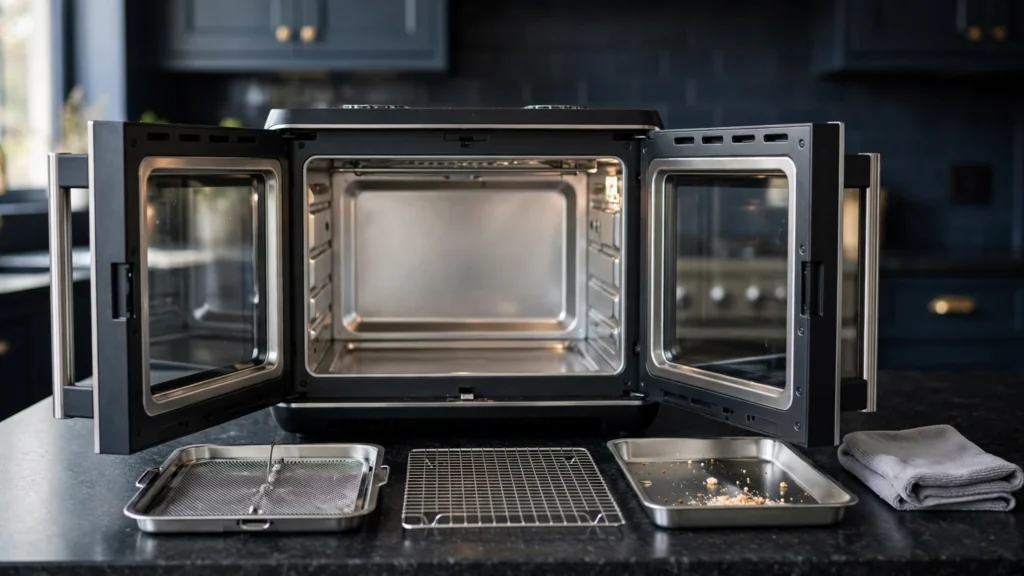
A French-door air fryer usually has more surfaces and accessories than a basic basket model.
You may need to clean:
- Air fryer basket
- Cooking trays
- Wire racks
- Crumb tray
- Interior walls
- Door glass
- Door edges
- Grease-prone areas
Grease and crumbs can accumulate quickly when cooking foods such as chicken wings, bacon, or other fatty foods.
A simple cleaning routine
After cooking:
- Let the appliance cool.
- Remove crumbs and loose food.
- Remove the tray and racks.
- Wash accessories according to the manufacturer’s instructions.
- Wipe the interior.
- Clean the door glass when necessary.
- Make sure everything is dry before the next use.
Don’t assume an accessory is dishwasher-safe unless the manufacturer says it is.
French Door Air Fryer Safety
Because these appliances combine high temperatures, heating elements, and moving hot air, basic safety matters.
Always follow the manufacturer’s instructions for:
- Minimum clearances
- Ventilation
- Maximum temperature
- Appropriate cookware
- Foil and parchment use
- Cleaning
- Electrical requirements
- Hot surfaces
- Door operation
Keep the appliance away from materials that could be damaged by heat.
And don’t block ventilation openings.
One more important point:
Never assume parchment paper or foil is safe simply because you’ve seen someone use it online.
Follow the specific manual for your model.
Who Should Buy a French Door Air Fryer?
A French-door model may make sense if you:
- Cook for several people
- Want larger cooking surfaces
- Frequently prepare flat foods
- Want air frying plus baking or roasting
- Want a countertop oven-style appliance
- Prefer tray access instead of a pull-out basket
- Have enough counter space
- Don’t mind cleaning additional accessories
It can be particularly useful when air frying is only one of several things you want the appliance to do.
Who Should Not Buy One?
A French-door air fryer may not be the best fit if you:
- Mostly cook for one or two people
- Mainly make fries and frozen snacks
- Have very limited counter space
- Want the simplest possible cleanup
- Prefer a compact appliance
- Rarely use baking, roasting, or toasting functions
In that situation, a smaller basket air fryer may provide the functions you actually use without taking up as much space.
French Door Air Fryer vs. Basket Air Fryer: Quick Decision Guide
| If You Mainly Want… | Consider |
|---|---|
| Quick meals for 1–2 people | Basket air fryer |
| Large batches | French door air fryer |
| Pizza and flat foods | French door air fryer |
| Toast and air fry in one appliance | French door air fryer |
| Minimal counter space | Basket air fryer |
| Simple everyday air frying | Basket air fryer |
| Baking + roasting + air frying | French door air fryer |
| Easy cleanup | Basket air fryer |
| Multiple cooking functions | French door air fryer |
| A compact appliance | Basket air fryer |
This isn’t about one design being universally better.
It’s about matching the appliance to how you actually cook.
French Door Air Fryer Buying Checklist
Before purchasing, ask these questions:
Cooking
- Does it have a dedicated air-fry tray or basket?
- Is airflow adequate around the food?
- Can you use multiple rack positions?
- Does the manufacturer provide useful cooking guidance?
Size
- Does it fit my counter?
- Can both doors open fully?
- Is there enough ventilation clearance?
- Can I store the accessories?
Capacity
- What are the actual tray dimensions?
- How much food fits in one layer?
- Is the advertised capacity useful for air frying?
Functions
- Air fry?
- Bake?
- Roast?
- Toast?
- Broil?
- Reheat?
- Dehydrate?
Only pay extra for functions you’ll actually use.
Cleaning
- Is the crumb tray removable?
- Are the racks easy to clean?
- How easy is the door glass to wipe?
- Which accessories are dishwasher-safe?
Everyday practicality
- Can you easily reach the food?
- Can you see the food while cooking?
- Is the control panel simple?
- Will you realistically leave it on the counter?
That final question is underrated.
A huge appliance that you hate moving is not very convenient.
Are French Door Air Fryers Worth It?
The answer depends on what you expect the appliance to replace.
If you’re buying one purely to make a small serving of fries quickly, its larger oven-style design may be unnecessary.
But if you want one countertop appliance that can air fry, bake, roast, toast, and handle larger foods, the format becomes much more practical.
Current product testing shows that some French-door models can produce strong air-frying results, but performance varies, and larger foods can take longer.
So the better question isn’t
“Are French door air fryers good?”
It’s:
“Does a French door air fryer fit the way I cook?”
That’s the question that should drive the purchase.
Frequently Asked Questions
What is a French door air fryer?
A French door air fryer is an oven-style countertop appliance with two front doors that meet in the middle. It typically combines air frying with other cooking functions.
Are French door air fryers better than basket air fryers?
Not automatically. Basket air fryers can be more convenient for small portions and everyday air frying, while French-door models can provide more cooking space and additional oven-style functions.
Do French door air fryers make food crispy?
They can produce crispy food when the appliance has effective airflow, suitable temperature control, and enough space around the food. The French-door design itself does not guarantee crispiness.
Are French door air fryers good for large families?
They can be useful for larger households because many models offer larger cooking cavities and tray-based cooking. However, check the actual usable tray size instead of relying only on the advertised capacity.
Do French door air fryers take more counter space?
Usually, yes. Their oven-style design generally requires more countertop space than compact basket models.
Are French door air fryers difficult to clean?
They can require more cleaning than basket air fryers because they may have multiple racks, trays, crumb trays, door glass, and a larger cooking chamber.
Can you bake in a French door air fryer?
Many models support baking, but the exact functions vary. Check the manufacturer’s specifications for the model you’re considering.
Can you cook pizza in a French door air fryer?
Many oven-style models are designed to accommodate pizza, but the actual pizza size depends on the interior and tray dimensions.
What should I check before buying a French door air fryer?
Check the usable tray dimensions, exterior size, door clearance, ventilation requirements, rack positions, airflow design, cleaning access, and included accessories.
Is a French door air fryer worth it for one person?
It may be more appliances than you need if you mainly prepare small portions. A compact basket air fryer may be simpler and take less counter space.
A Simple Rule for Choosing One
If your priority is
Small portions + speed + simplicity → basket air fryer
Large portions + tray cooking + multiple functions → French door air fryer
Both → compare the actual cooking area and countertop footprint before deciding.
Don’t let the door design make the decision for you.
Final Conclusion
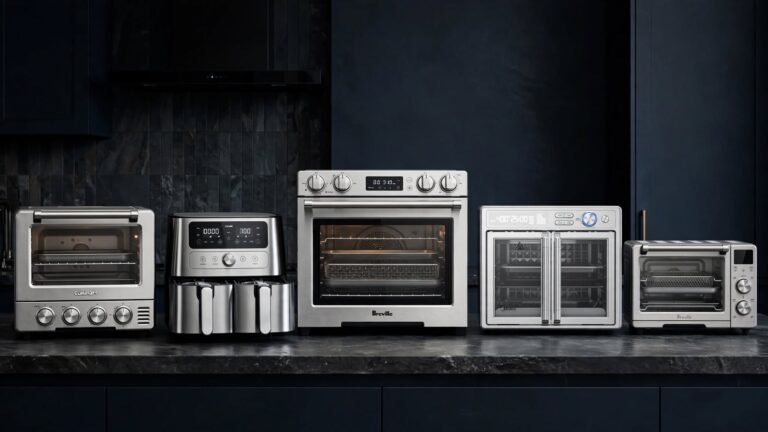
A French door air fryer sits somewhere between a traditional basket air fryer and a compact countertop oven.
Its biggest advantage isn’t simply the two doors. The real attraction is the combination of a larger cooking space, tray access, and multiple cooking functions.
That makes the format useful for people who want to air fry but also bake, roast, toast, reheat, or cook larger foods.
The tradeoff is equally important.
These appliances can take more counter space, involve more parts to clean, and may be unnecessary for someone who only wants quick small-batch air frying.
So before buying one, don’t focus only on the quart number or the number of cooking presets.
Check the actual tray size, airflow, rack layout, door clearance, ventilation requirements, and cleaning access.
That’s how you find out whether a French door air fryer is genuinely useful for your kitchen rather than simply impressive on a product page.