Microwave Air Fryer Combo: How It Works, Uses, Pros & Cons
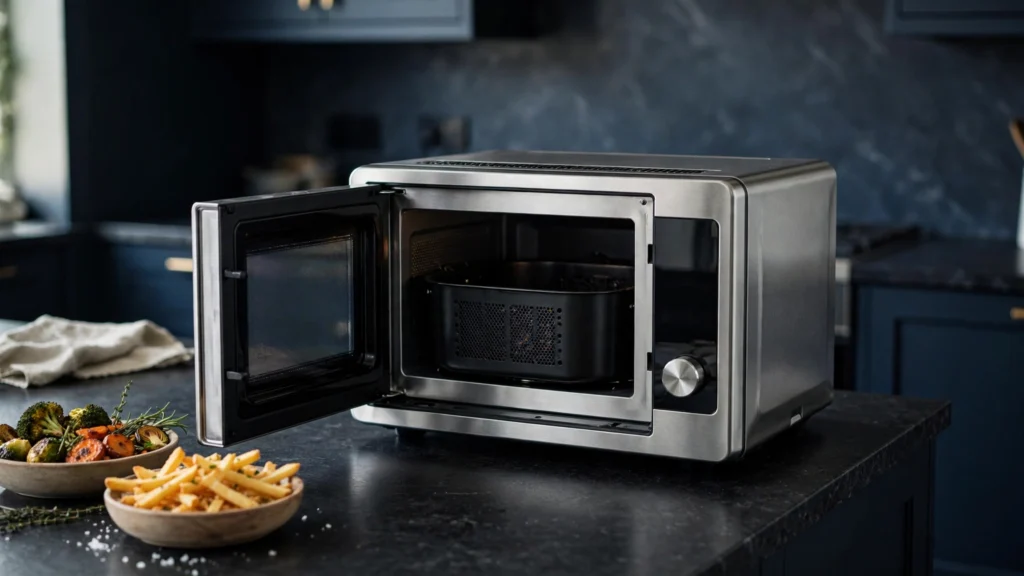
A microwave air fryer combo combines two different cooking methods in one countertop appliance. It can heat and reheat food using microwave energy while also using a heating element and fan to circulate hot air for browning and crisping.
Depending on the model, you may also get convection baking, roasting, broiling, grilling, or other cooking modes. That makes these appliances appealing when countertop space is limited or when you want several cooking functions without keeping multiple appliances on the counter.
But there is an important distinction: having an air fry setting does not automatically mean a combination microwave will behave exactly like a dedicated basket-style air fryer. The cooking cavity, airflow design, cooking surface, capacity, and accessories can all affect the result.
This guide explains what a microwave air fryer combo actually does, how its different modes work, what foods suit it, where it has limitations, and what to look for before buying one.
What Is a Microwave Air Fryer Combo?
A microwave air fryer combo is a single appliance that combines microwave cooking with an air-frying function. Many models add convection cooking and other oven-style functions as well.
The microwave side uses electromagnetic energy to heat food, while the air-fry function uses a heating element and fan to circulate hot air around the food. In air-fry mode, the microwave cooking system may be inactive, depending on the appliance’s design and instructions.
This distinction matters because microwave cooking and air frying solve different cooking problems.
A microwave is particularly useful when you want to heat or cook food quickly. Air frying is designed around circulating hot air to brown and crisp the food’s exterior.
Some combination appliances also include convection heating. That can make the appliance useful for baking and roasting in addition to microwave heating and air frying.
Is a Microwave Air Fryer the Same as a Regular Air Fryer?
No.
A dedicated air fryer is designed primarily around hot-air circulation and usually has a basket or cooking drawer that encourages airflow around the food.
A microwave air fryer combo has a larger, more conventional microwave-style cavity and has to accommodate multiple cooking systems. Some use an air-fry basket, while others use racks, trays, or specialized accessories.
That difference can affect how much food you can spread out and how evenly it browns.
How Does a Microwave Air Fryer Combo Work?
The easiest way to understand these appliances is to separate the cooking systems.
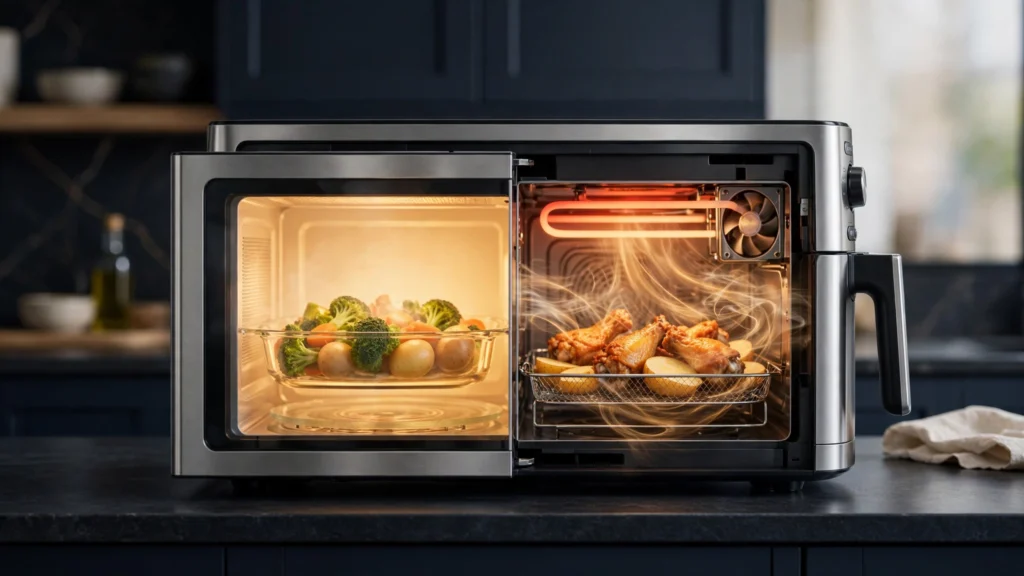
How the Microwave Function Works
A microwave heats food using electromagnetic energy. This makes it particularly useful for reheating leftovers, warming liquids, defrosting appropriate foods, and quickly heating prepared meals.
Microwave cooking is not designed primarily to create the dry, browned exterior associated with air frying.
How the Air Fryer Function Works
The air-fry function uses a heating element and fan to move hot air around the food. That circulating heat helps remove surface moisture and promotes browning.
Many models use a perforated basket or rack to allow hot air to reach more of the food’s surface. Whirlpool, for example, describes its air-fry microwave models as using a heating element, fan, and air-fry basket for this purpose.
How the Convection Function Fits In
Convection cooking also uses a heating element and fan to circulate hot air.
The terminology can therefore become confusing. A product might be described as a microwave air fryer, air fryer microwave, convection microwave, or microwave air fryer convection oven, even though the exact cooking systems and accessories vary by model.
The important thing is not the label alone. Check the actual cooking modes and manufacturer instructions.
What Each Cooking Mode Does
| Cooking Mode | Main Purpose | Typical Result |
|---|---|---|
| Microwave | Fast heating and cooking | Hot food with moisture retained |
| Air Fry | Browning and crisping | Drier, more browned exterior |
| Convection | Baking and roasting | More oven-like cooking |
| Broil/Grill | Surface browning | Browner top or exterior |
| Combination Mode | Uses multiple cooking technologies where supported | Faster or different cooking results depending on the model |
Not every microwave air fryer combo includes all of these modes, and the exact way the modes operate differs between appliances.
That is why the model’s manual should always take priority over generic cooking advice.
Microwave vs. Convection vs. Air Fryer
These three terms are often mixed together, but they are not interchangeable.
A microwave uses electromagnetic energy to heat food.
A convection oven uses a heating element and fan to circulate hot air.
An air fryer is essentially a compact cooking system built around circulating heated air, usually with a cooking basket or tray designed to encourage airflow.
Convection microwaves can therefore cook some of the same foods as air fryers, but their physical design can be different. CHOICE notes that conventional air fryers commonly position their heating element and fan above the food, while convection microwaves may use a different cavity layout.
That design difference is one reason two appliances with an “air fry” label can produce different results.
Can a Microwave Air Fryer Actually Make Food Crispy?
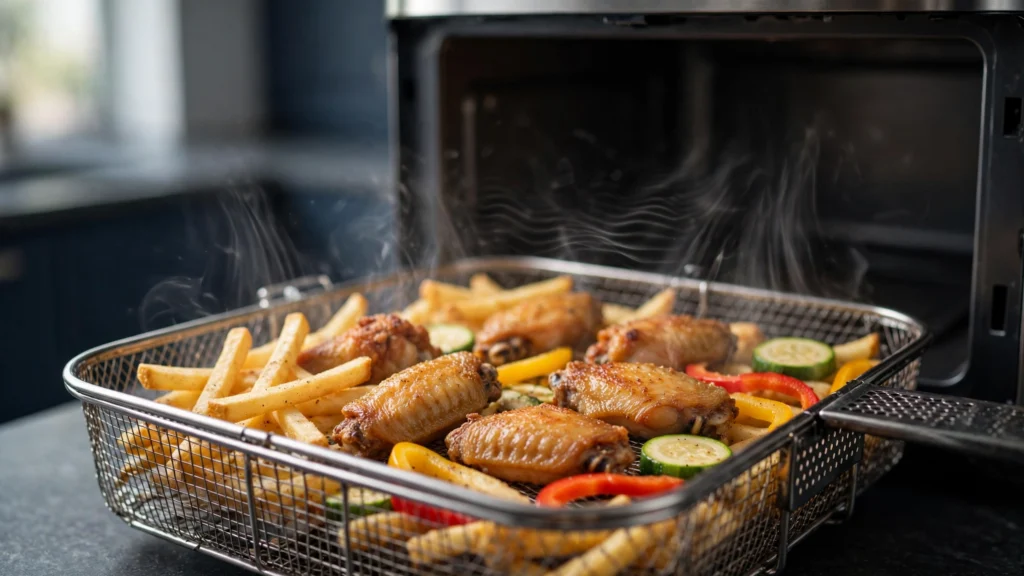
Yes, it can, but the results depend heavily on the appliance and how the food is arranged.
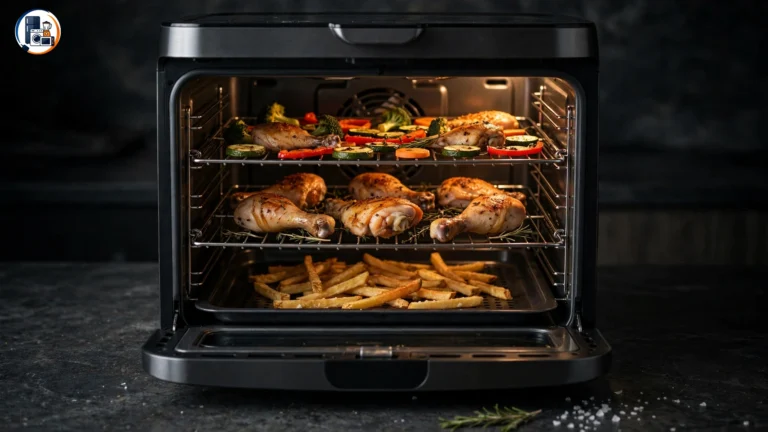
Air frying works by exposing food to circulating dry heat. For foods such as frozen fries, chicken wings, breaded foods, and roasted vegetables, that can encourage browning and a crisp exterior.
But crispiness is not controlled by the appliance alone.
Food quantity, surface moisture, thickness, airflow, cooking temperature, and the available cooking surface all matter.
For example, putting a thin layer of fries on a perforated surface gives hot air more opportunities to reach the food. Piling too much food together can restrict airflow and lead to softer or less evenly browned results.
This is one reason a microwave air fryer combo should not automatically be judged by the word “air fryer” on its control panel.
What Can You Cook in a Microwave Air Fryer Combo?
A microwave air fryer combo can be useful for a wide range of everyday foods.
Foods That Can Work Well With Air Fry Mode
- French fries
- Chicken wings
- Chicken nuggets
- Breaded fish
- Salmon
- Roasted vegetables
- Potatoes
- Bacon
- Sausage
- Frozen snacks
- Pizza
- Small portions of chicken
- Reheated foods that you want to crisp
The best mode depends on the food.
For example, reheating soup is a natural microwave task, while crisping leftover fries may be better suited to the air-fry function.
Frozen fries and breaded foods can benefit from circulating hot air, while delicate foods may require more careful temperature and time adjustments.
Foods Better Suited to the Microwave Function
Microwave mode is generally more useful for foods where speed and moisture retention matter.
Examples include:
- Soup
- Sauces
- Beverages
- Leftover rice
- Steamed vegetables
- Microwaveable prepared meals
The advantage of the combo is that you can choose the cooking method according to the food instead of using one method for everything.
What Affects Air-Frying Results?
A microwave air fryer combo can produce good crisping, but several variables affect the outcome.
| Factor | What Can Happen |
|---|---|
| Overcrowding | Restricts airflow and can cause uneven browning |
| Wet food surface | Can reduce crisping |
| Food thickness | Thicker pieces generally need more cooking time. |
| Airflow | Better circulation can improve browning. |
| Cooking surface | Affects how much food can be spread out |
| Food quantity | Larger batches can require more time or multiple rounds. |
| Starting temperature | Frozen and refrigerated foods may cook differently. |
| Appliance design | Fan position, heating element, cavity size, and accessories affect results. |
This is why there is no universal temperature or cooking time that works perfectly for every microwave air fryer combo.
If food is coming out soft, increasing the temperature immediately is not always the best first move. Check the food quantity, spacing, moisture, thickness, and airflow first.
How Much Food Can You Actually Air Fry at Once?
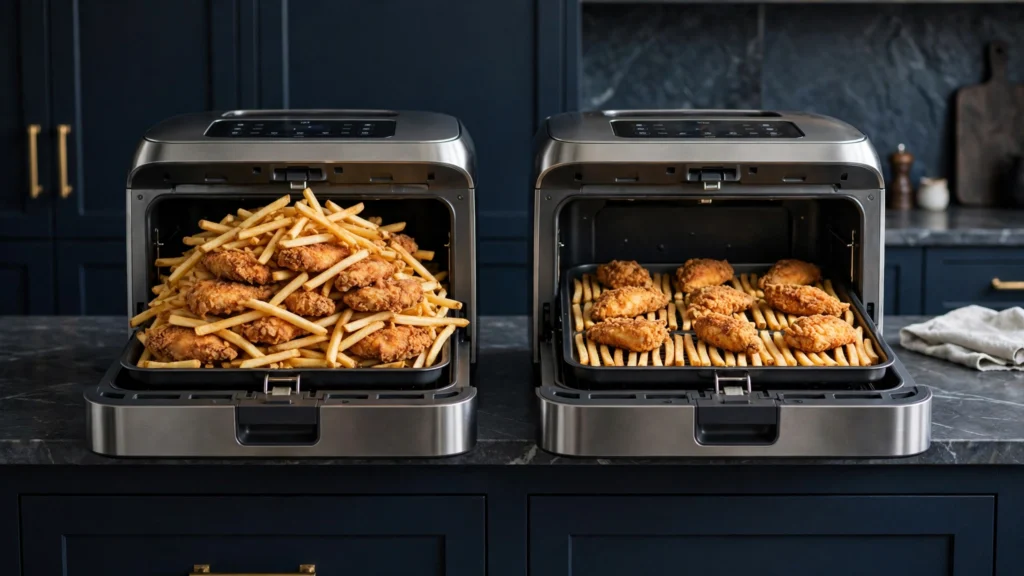
This is one of the most overlooked parts of buying a combination appliance.
Advertised capacity is not the same as usable air-frying space.
A microwave might have a relatively large internal cavity, but air-frying often works best when food is spread out enough to allow hot air to circulate.
A larger cavity, therefore, does not automatically mean you can fill every inch with food and still get evenly crisp results.
The same principle applies to standalone air fryers. When comparing capacities, it is useful to think about the usable cooking surface, not just the number printed on the box.
If you’re comparing a combination appliance with a standalone unit, our guide to a 6-quart air fryer can help explain how advertised capacity relates to practical cooking space: 6-quart air fryer
For larger batches, you may get better results by cooking in multiple rounds rather than overcrowding the cooking surface.
Microwave Air Fryer Combo vs. Regular Air Fryer
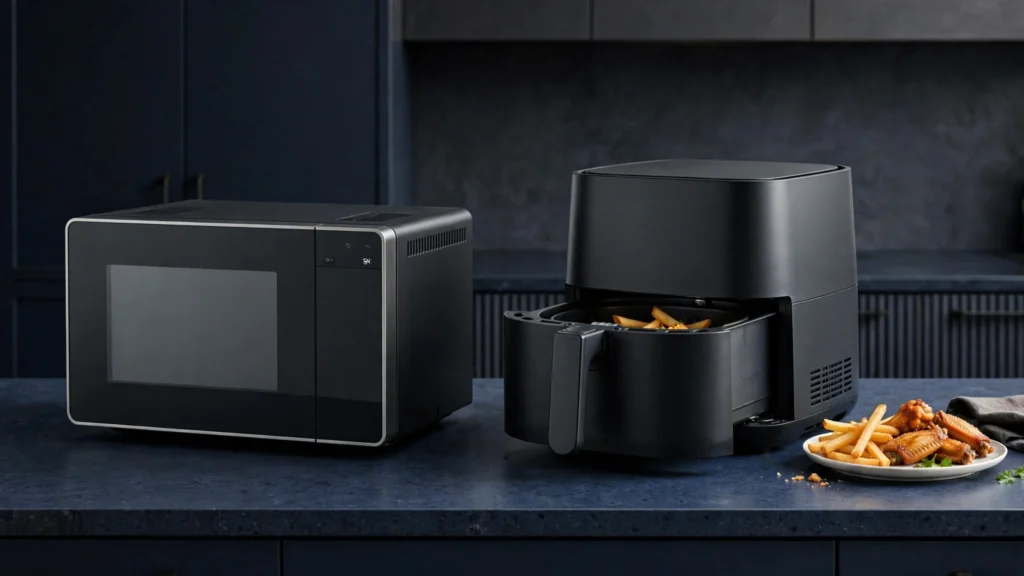
Both can circulate hot air, but their designs serve different priorities.
| Feature | Microwave Air Fryer Combo | Regular Air Fryer |
|---|---|---|
| Microwave heating | Yes. | No |
| Air-frying function | Yes, if included. | Yes. |
| Convection cooking | Often available | Depends on model |
| Countertop consolidation | Strong advantage | Requires separate microwave |
| Reheating liquids | Microwave function | Not its main purpose |
| Crisping | Depends on the model and airflow design | Designed primarily around air frying |
| Cooking space | Model dependent | Model dependent |
| Controls | Can be more complex | Usually more focused |
| Best suited to | Multi-function cooking | Dedicated air frying |
Which Gives Better Air-Frying Results?
There is no universal answer for every model.
A dedicated air fryer is specifically designed around air circulation and crisping. Some microwave air fryer combos can also produce good air-fried food, but the physical design and cooking accessories can be different.
CHOICE notes that convection microwaves can cook similar foods to air fryers, while their larger cavity and different heating arrangement create different trade-offs.
The right comparison therefore depends on what matters most to you: dedicated air-frying performance, microwave convenience, capacity, countertop space, or having several functions in one appliance.
Microwave Air Fryer Combo Pros and Cons
A combination appliance can solve a real kitchen-space problem, but it also introduces trade-offs.
| Pros | Cons |
|---|---|
| Combines microwave and air-frying functions in one appliance | Usually costs more than a basic microwave or air fryer |
| Can reduce the number of countertop appliances | Air-frying performance varies by model. |
| Convenient for reheating and crisping different foods | Usable air-frying space may be smaller than expected. |
| Can also provide convection or other cooking modes | Controls can be more complicated. |
| Useful for smaller kitchens | Cleaning can involve more components and surfaces. |
| Allows different cooking methods in one appliance | A dedicated air fryer may be better suited to frequent air frying. |
| Can be useful for reheating foods that need crisping | Large batches may require multiple rounds |
| Can provide microwave, oven-style, and air-fry functions depending on the model | Accessories may have different restrictions for different cooking modes. |
The biggest trade-off is simple: versatility versus specialization.
A combination appliance can do more jobs, while a dedicated air fryer is built around one particular style of cooking.
What a Microwave Air Fryer Combo Cannot Do
A microwave air fryer combo is versatile, but it should not be treated as a magical replacement for every kitchen appliance.
It Cannot Guarantee the Same Results as Every Dedicated Air Fryer
Airflow design, cooking surface, cavity size, and food placement vary.
It Cannot Make Overcrowding Work
Air frying still needs adequate airflow. Adding more food does not automatically make the process more efficient.
It Cannot Eliminate the Need for Mode-Specific Cookware
Some models use baskets or racks that are intended for particular functions. An accessory that is suitable for air frying may not necessarily be suitable for microwave operation.
It Cannot Make Every Food Suitable for Air Frying
Some foods are better suited to microwave, convection, or conventional cooking.
It Cannot Replace the Manufacturer’s Instructions
This is especially important with combination appliances because different modes can have different cookware and safety requirements.
Are Microwave Air Fryer Combos Worth It?
Whether a microwave air fryer combo is worth buying depends on how you actually cook.
For someone who wants microwave heating plus occasional air frying, having both functions in one appliance can be convenient.
For someone who mainly wants crispy air-fried food several times a week, a dedicated air fryer may deserve more attention because its design is focused specifically on air circulation and crisping.
The key is to evaluate the appliance based on your actual priorities rather than simply counting the number of cooking functions.
A machine with six or eight modes is not automatically more useful than a simpler appliance if you mainly use one function.
When a Microwave Air Fryer Combo May Not Be the Right Choice
A combination appliance may not be the best fit if:
- You already have a microwave you like.
- Your main goal is dedicated air frying.
- You regularly cook large batches of crispy food.
- You prefer very simple controls.
- You have enough countertop space for separate appliances.
- You want maximum flexibility in how you arrange food in an air-fryer basket.
- You rarely use microwave functions.
In those situations, separating the two appliances may make more sense.
What to Look for in a Microwave Air Fryer Combo
Don’t judge a model only by its feature count.
Cooking Capacity
Look at the actual cooking area and included air-fry accessories.
Ask:
- How much food can fit in a useful single layer?
- Does the air-fryer basket provide enough surface area?
- Can the food be spread out?
- Will the door and countertop layout work in your kitchen?
Airflow and Air-Fry Design
Look for information about:
- Fan placement
- Heating element placement
- Air-fry basket or tray
- Perforated cooking surfaces
- Food positioning
These details can matter more to air-frying results than simply having an “Air Fry” button.
Microwave Power
Check the manufacturer’s listed microwave power and available power levels.
Higher power is not automatically better for every food. What matters is whether the appliance gives you the control and performance you need.
Convection Function
If you want baking or roasting as well as air frying, check whether the appliance actually includes convection cooking.
Don’t assume that an “air fry” label means every oven-style function is included.
Controls and Presets
Consider whether you prefer:
- Manual time and temperature settings
- Food presets
- Multiple cooking modes
- Combination programs
More controls can provide flexibility, but they can also increase the learning curve.
Cleaning and Maintenance
Check:
- Removable trays
- Air fryer basket
- Interior surfaces
- Grease buildup areas
- Whether accessories are dishwasher-safe, if the manufacturer specifies that they are
Countertop Size and Clearance
Measure the appliance before buying it.
Also check the manufacturer’s required ventilation and clearance instructions. A countertop appliance needs more than enough space to physically fit. It also needs an appropriate location for safe operation.
How to Use a Microwave Air Fryer Combo
The exact controls vary by model, but a general process looks like this:
- Choose the cooking mode appropriate for the food.
- Prepare the food according to the recipe or manufacturer’s guidance.
- Use the correct cookware or accessory for that mode.
- Arrange food so air can circulate when using an air fryer.
- Set the appropriate temperature and cooking time.
- Check the food according to the appliance instructions.
- Remove hot food and accessories carefully.
- Allow appropriate parts to cool before cleaning.
- Clean food residue and grease from the appliance as recommended.
Don’t assume that a recipe written for a basket-style air fryer will transfer perfectly to a microwave air fryer combo.
The cooking environment can be different.
How to Get Better Air-Frying Results
If your food is coming out less crispy than expected, look at the basics before changing everything at once.
Avoid Overcrowding
Give hot air enough room to move around the food.
Keep the Surface Reasonably Dry
Excess surface moisture can interfere with browning.
Use the Right Amount of Oil
Air frying usually requires much less oil than deep frying, but some foods benefit from a light coating.
Too much oil can make food greasy, while some foods may brown better with a small amount.
Consider Food Thickness
Thicker pieces can require different cooking times from thin pieces.
Spread Food Across the Cooking Surface
A single, reasonably spaced layer can provide more consistent exposure to circulating heat.
Don’t Judge the Appliance After One Food
Different foods respond differently to hot-air cooking.
Frozen fries, chicken wings, salmon, broccoli, and breaded fish all have different moisture levels and structures.
Common Mistakes to Avoid
Overcrowding the Air-Fry Basket or Tray
This is one of the easiest ways to restrict airflow.
Using the Wrong Cookware
Never assume that an accessory is safe in every mode.
Treating Microwave and Air-Fry Settings the Same
They use different cooking methods, so their timing and results are not interchangeable.
Ignoring Food Spacing
Even with a good appliance, tightly packed food can cook unevenly.
Assuming Every Model Performs the Same
A microwave air fryer combo is not a standardized appliance design. Manufacturers use different cavity layouts, fans, heating elements, baskets, and controls.
Using Too Much Oil
More oil does not automatically mean crispier food.
Ignoring Ventilation Requirements
Follow the manufacturer’s placement and clearance instructions.
Assuming Advertised Capacity Equals Air-Frying Capacity
The total cavity size doesn’t tell the whole story.
Microwave Air Fryer Combo Safety
Safety deserves more attention with a combination appliance because different cooking modes can have different requirements.
Follow the Manufacturer’s Instructions
This should always be the starting point.
Use Appropriate Cookware
Only use cookware and accessories that the manufacturer identifies as suitable for the selected mode.
Can You Use Metal in a Microwave Air Fryer Combo?
It depends on the appliance and the cooking mode.
This is not an area where a blanket “yes” or “no” answer is appropriate.
Some microwave air fryer combos are specifically designed to use metal racks, trays, or air-fry baskets for certain functions. That does not mean every metal accessory is safe during microwave operation.
Check the manufacturer’s instructions for the exact accessory and mode before using it.
Keep Ventilation Areas Clear
Do not block ventilation openings or place the appliance somewhere that conflicts with its required clearances.
Be Careful With Hot Accessories
Air fryer baskets, racks, trays, and the interior cavity can become very hot.
Use appropriate protection when removing them.
Clean Grease and Food Residue
Accumulated grease and food residue can create unpleasant smoke and can make the appliance harder to maintain.
Regular cleaning is part of safe, reliable use.
Does Air Frying in a Microwave Take Longer Than a Regular Air Fryer?
There is no universal cooking time that applies to every microwave air fryer combo.
Cooking time can change based on:
- Appliance design
- Airflow
- Food quantity
- Food thickness
- Starting temperature
- Cooking surface
- Temperature setting
- Whether the food is frozen or refrigerated
Some combination microwaves can produce good air-fried results, but the larger cavity and different heating arrangement can change how heat reaches the food.
That means you should treat air-fryer cooking times as starting points, not guarantees.
If a recipe was written specifically for a basket-style air fryer, use the appliance’s instructions and monitor the food rather than assuming the same timing will produce the same result.
Common Expectations That Can Lead to Disappointing Results
A few assumptions can make combination appliances seem worse than they actually are.
“More Functions Automatically Means Better Air Frying”
Not necessarily.
More functions mean more versatility, but air-frying performance still depends on airflow, heating, cooking surface, and food placement.
“A Bigger Capacity Means I Can Cook More Crispy Food”
Not always.
The air-fry function may require food to be spread across a particular tray or basket.
“Every Microwave Air Fryer Works the Same Way”
They don’t.
The technology and accessory design vary between models.
“I Can Fill the Whole Cavity”
Air frying generally benefits from adequate airflow around the food.
“The Same Recipe Will Work Exactly the Same”
A recipe developed for one appliance may require adjustment when used in another.
How to Choose Between a Combo and a Dedicated Air Fryer
The decision becomes easier when you focus on how you cook.
A Microwave Air Fryer Combo May Suit You If:
- You need both microwave and air-fry functions.
- Countertop consolidation matters.
- You reheat food frequently.
- You want convection or oven-style functions as well.
- You prefer one multi-purpose appliance.
A Dedicated Air Fryer May Suit You If:
- Air frying is your primary goal.
- You frequently cook crispy foods.
- You want a cooking appliance focused mainly on air circulation.
- You regularly prepare batches that need a wide cooking surface.
- You prefer simpler controls.
Neither setup is automatically right for everyone.
The useful question is
Which cooking functions will you actually use most often?
Microwave Air Fryer Combo FAQs
Can you air fry in a microwave?
Yes, if the microwave is specifically designed with an air-fry function. These appliances use a heating element and fan to circulate hot air during the air-fry mode.
How does a microwave air fryer combo work?
It combines microwave heating with a separate hot-air cooking system. Depending on the model, it may also include convection, grilling, broiling, or other cooking modes.
Is a microwave air fryer better than a regular air fryer?
That depends on your priorities. A combo provides microwave functionality and potentially other cooking modes, while a dedicated air fryer is focused primarily on air frying.
Can you cook frozen fries in a microwave air fryer combo?
Many models can air fry frozen foods such as fries, but the appropriate temperature, time, food quantity, and accessory depend on the appliance and the food.
Does a microwave air fryer make food crispy?
It can. The air-fry function uses circulating hot air to encourage browning and crisping. Results depend on airflow, food spacing, moisture, quantity, and the appliance’s design.
Can you use metal in a microwave air fryer combo?
Only when the manufacturer specifically permits the particular metal accessory for the selected cooking mode. Never assume that an accessory safe for air frying is automatically safe during microwave operation.
Are microwave air fryer combos worth it?
They can be useful for people who want microwave heating and air frying in one appliance, particularly where countertop space matters. Someone focused mainly on air frying may prefer a dedicated air fryer.
What can you cook in a microwave air fryer combo?
Depending on the model, you can prepare or reheat foods such as fries, chicken wings, nuggets, vegetables, salmon, pizza, bacon, sausage, leftovers, and microwaveable meals.
Does an air fryer microwave replace a regular microwave?
If the appliance includes a full microwave function, it can perform microwave tasks. The exact capabilities, power, capacity, and cooking modes depend on the model.
Is a microwave air fryer combo safe?
It can be safely used when operated according to the manufacturer’s instructions. Pay particular attention to cookware restrictions, mode-specific accessories, ventilation, hot surfaces, and cleaning.
Final Conclusion
A microwave air fryer combo can be a useful solution when you want microwave heating, air frying, and potentially convection or other cooking functions in one appliance.
Its biggest advantage is versatility. Instead of choosing between a microwave and an air fryer for every cooking task, you can select the mode that fits the food.
But versatility does not guarantee identical performance across every function. Air-frying results depend on the appliance’s heating system, airflow, cooking surface, food quantity, moisture, thickness, and how the food is arranged.
The most important thing to remember is that advertised capacity and the number of cooking modes don’t tell the whole story. Look at the actual air-frying surface, accessories, controls, ventilation requirements, cleaning needs, and the cooking functions you will realistically use.
If your priority is having multiple cooking methods in one appliance, a microwave air fryer combo can make practical sense. If your priority is dedicated air frying and frequent crispy-food cooking, a standalone air fryer may better match that specific use case.
In the end, the right choice is less about having the most functions and more about choosing the setup that fits the way you actually cook.