Non-Toxic Air Fryers: PFAS, PTFE & Ceramic Safety Guide
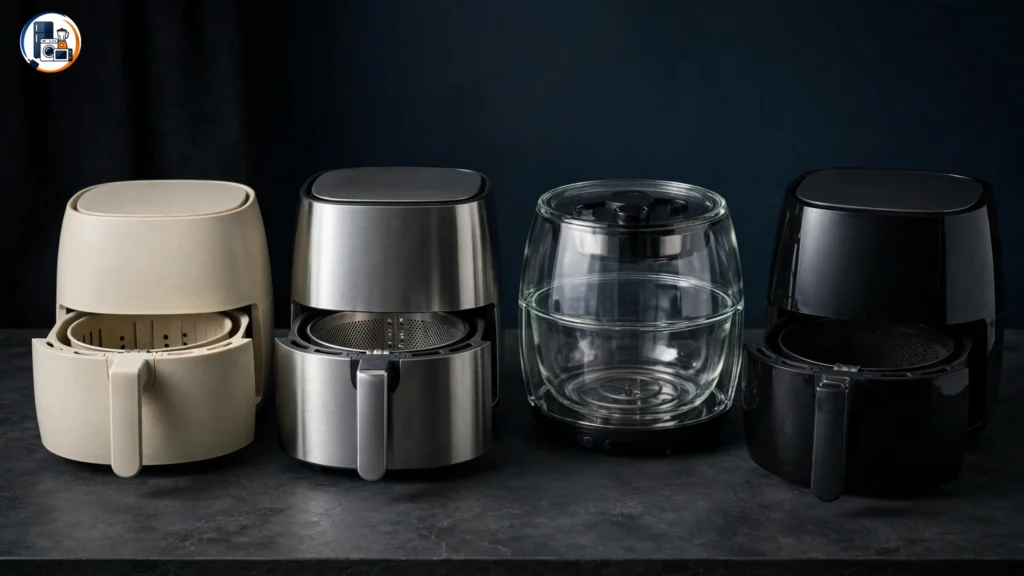
When people search for a non-toxic air fryer, they usually want a simple answer: which materials should touch their food, and which ones should they avoid?
The problem is that “non-toxic” is not a standardized air-fryer category. Marketing pages often use terms such as PFAS-free, PTFE-free, PFOA-free, ceramic-coated, stainless steel, glass, and chemical-free as if they all mean the same thing. They do not.
The more useful way to evaluate an air fryer is to look past the marketing label and identify what actually touches the food, whether that surface is coated, what the manufacturer specifically says about the material, and whether the claim applies to the exact model you are considering.
This guide breaks down the differences between PFAS, PTFE, PFOA, ceramic coatings, stainless steel, and glass, then turns those details into a practical buying checklist.
Are Air Fryers Non-Toxic?
There is no single material that automatically makes an air fryer “non-toxic.”
An air fryer is a collection of materials: the basket or cooking chamber, crisper plate, handles, seals, heating components, interior surfaces, and sometimes racks or other accessories. The part that deserves the closest attention is the food-contact surface, because that is where your food actually sits.
A model with a stainless steel exterior can still have a coated cooking basket. Likewise, an air fryer advertised as ceramic-coated may contain stainless steel elsewhere in the appliance.
So instead of asking:
“Is this air fryer non-toxic?”
A better question is
“What materials are used on the surfaces that come into direct contact with my food?”
That shift makes shopping much easier.
The FDA treats cookware and other food-contact materials according to their intended use and considers factors such as whether substances can migrate into food. That is more useful than treating an entire material category as automatically safe or unsafe.
What Does “Non-Toxic” Actually Mean?
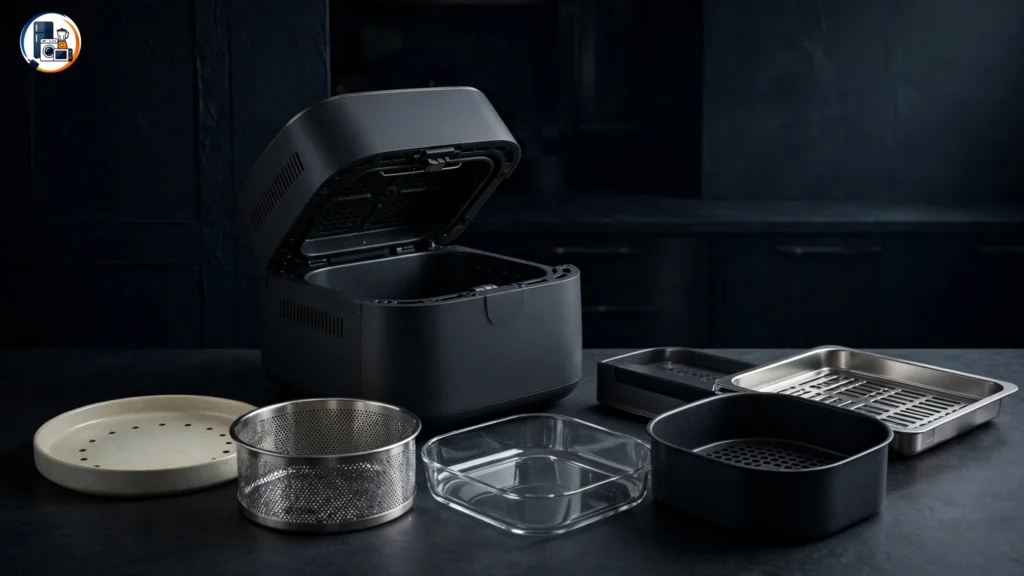
“Non-toxic air fryer” is primarily a consumer and marketing phrase, not a universal technical classification.
That matters because two products can both advertise themselves as “non-toxic” while using completely different construction.
One might use:
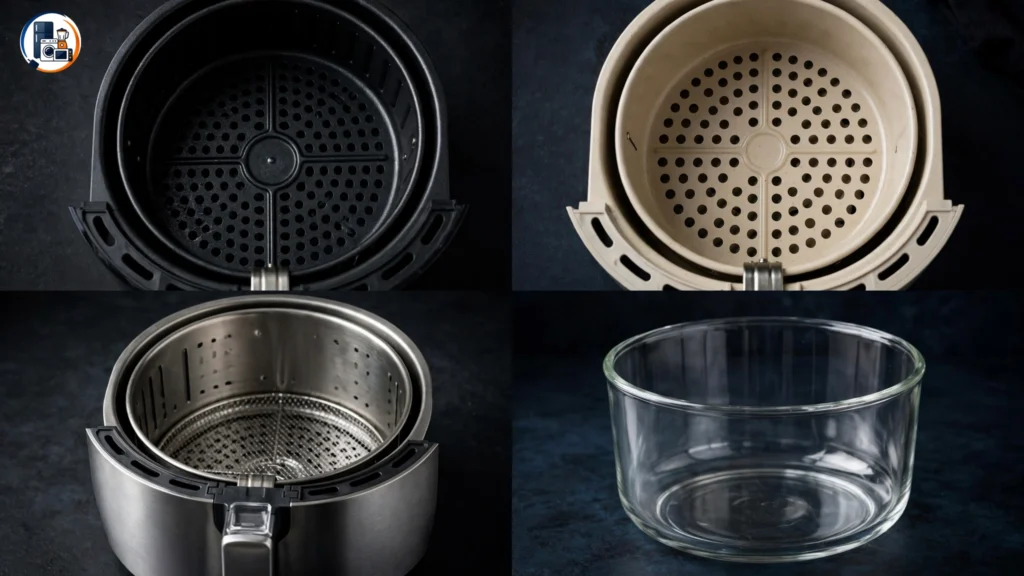
- A PTFE-based nonstick coating
- A ceramic-based coating
- Bare stainless steel
- Tempered glass
- A combination of several materials
Those designs should not be treated as interchangeable.
There is also a difference between these statements:
- PFAS-free
- PTFE-free
- PFOA-free
- No nonstick coating
- Stainless steel cooking surface
- Glass cooking vessel
Each describes something different.
For that reason, the strongest buying decision comes from identifying the actual construction rather than relying on the broad phrase “non-toxic.”
Why the Food-Contact Surface Matters
The outside of an air fryer tells you surprisingly little about what touches your food.
A model can have a stainless steel housing while its removable basket uses a nonstick coating. Another may have a glass cooking bowl with stainless steel accessories.
Think of the air fryer as a small cooking system rather than one material.
Check these parts first.
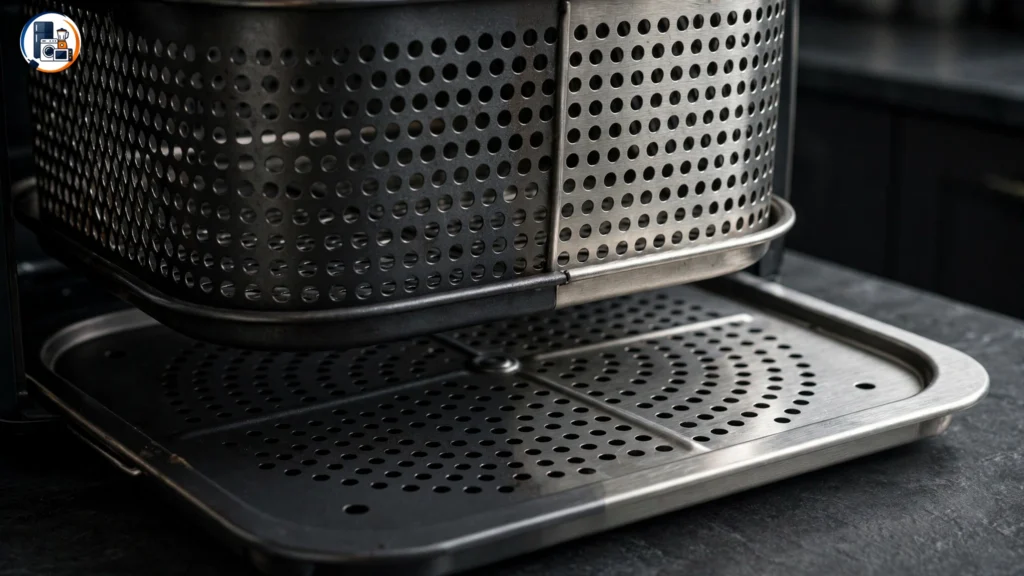
- Main basket or cooking bowl
- Crisper plate
- Cooking racks
- Rotisserie accessories
- Any removable tray that directly holds food
- Interior cooking surfaces
This is especially important when shopping for a model described as “stainless steel.” The phrase may refer to the body, not necessarily the entire food-contact system.
That distinction can completely change what you’re buying.
PFAS in Air Fryer Coatings
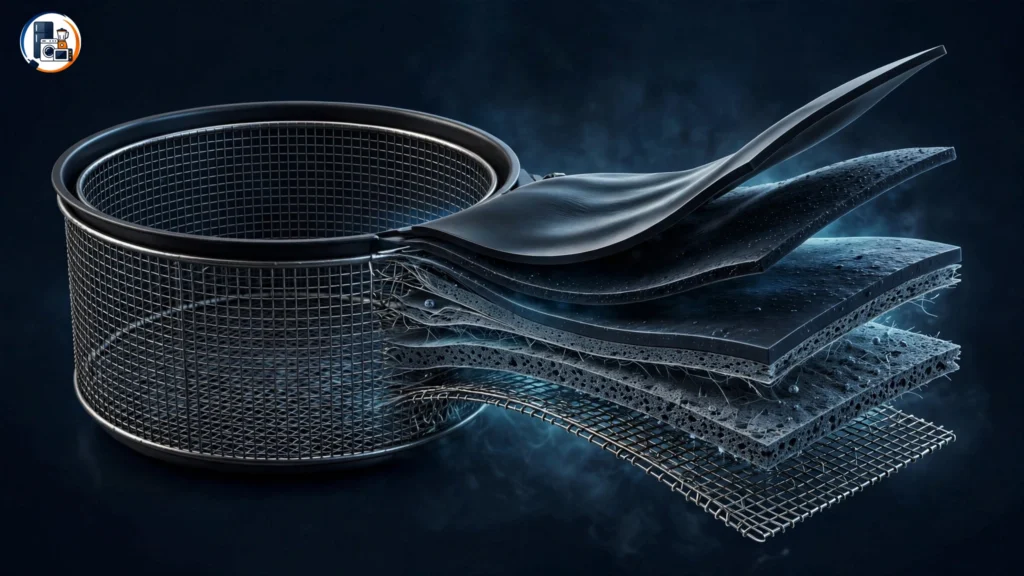
PFAS stands for per- and polyfluoroalkyl substances, a very broad family of chemicals rather than one single substance.
Some PFAS have been used in food-contact applications, including certain nonstick cookware coatings. The FDA explains that authorized nonstick applications can involve highly polymerized PFAS materials that are tightly bound to the cookware surface, with studies showing negligible migration of PFAS from those coatings to food under the evaluated uses.
That does not mean every PFAS-related product should be treated identically.
The chemistry, formulation, intended use, manufacturing process, and potential migration all matter.
For shoppers who specifically want to avoid PFAS-containing cooking surfaces, the practical approach is simpler:
Look for a model that explicitly identifies its food-contact surfaces as PFAS-free, or choose a design that does not rely on a nonstick coating for the cooking surface.
Do not assume that a generic “nonstick” label tells you enough.
Is PTFE the Same as Teflon?
Not exactly.
PTFE stands for polytetrafluoroethylene. Teflon is a well-known brand associated with PTFE-based nonstick products.
In everyday cookware discussions, people often use “Teflon” and “PTFE” interchangeably, but they are not technically identical terms.
For air fryer shopping, the practical question is usually
Does this model use a PTFE-based nonstick cooking surface?
If you want to avoid PTFE, look for an explicit PTFE-free claim covering the food-contact surfaces.
Do not assume that “PFOA-free” automatically means “PTFE-free.”
PFOA-Free vs. PFAS-Free
This is one of the easiest places to get confused.
PFOA is one specific chemical within the broader PFAS family.
Therefore:
PFOA-free does not automatically mean PFAS-free.
A product can make a PFOA-free claim without making a broader claim about the entire PFAS category.
If avoiding PFAS is your priority, look for wording that specifically says PFAS-free, rather than stopping at PFOA-free.
The same principle applies to other marketing language. A narrow claim should not automatically be interpreted as a much broader one.
A useful rule
Read the exact claim, not the claim you wish the label had made.
That one habit prevents a lot of confusion.
Are Ceramic Air Fryers a Better Choice?
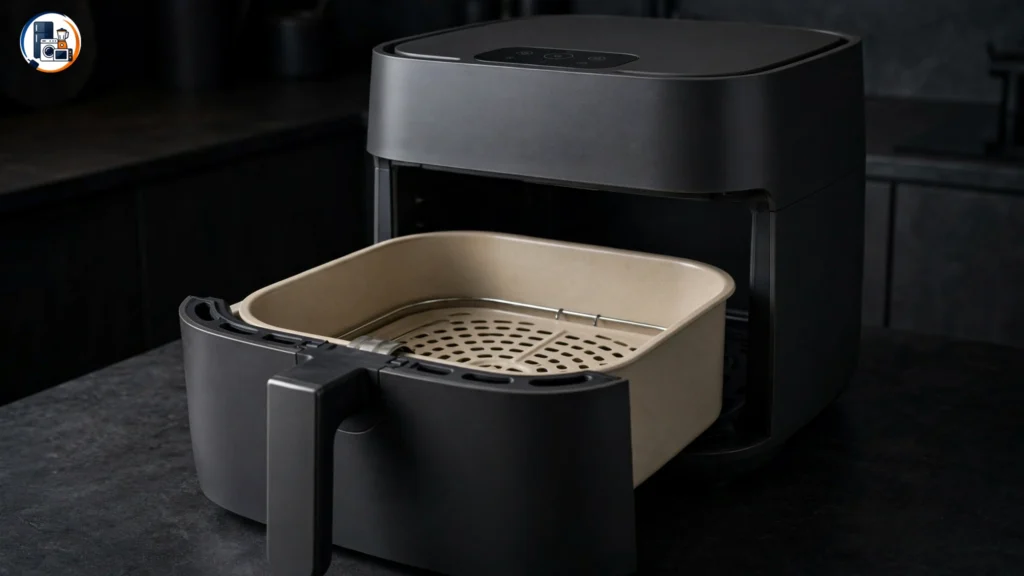
Ceramic-coated air fryers have become popular with shoppers who want a nonstick surface without PTFE.
But “ceramic” deserves a little more scrutiny than the label suggests.
A ceramic-coated cooking basket can provide a nonstick surface while avoiding PTFE. However, ceramic coating does not automatically prove that a product is PFAS-free.
The specific formulation and manufacturer claim matter.
For example, COSORI’s current Iconic 6.5-quart model is described by the manufacturer as having ceramic-coated basket and crisper-plate cooking surfaces that are free of PFAS and PTFE.
That is much more useful than simply seeing the word “ceramic” on a product listing.
What ceramic coatings offer
Potential advantages:
- Nonstick cooking surface
- Can be marketed without PTFE
- Easier food release than bare metal
- Available on several modern air fryers
Things to consider:
- It is still a coating
- Exact formulation varies by manufacturer
- “Ceramic” alone does not establish every chemical property you may care about
- Care instructions still matter
If your goal is to avoid PTFE and PFAS, a specific PFAS-free and PTFE-free ceramic cooking surface is a much stronger claim than simply “ceramic-coated.”
Are Stainless Steel Air Fryers a Better Option?
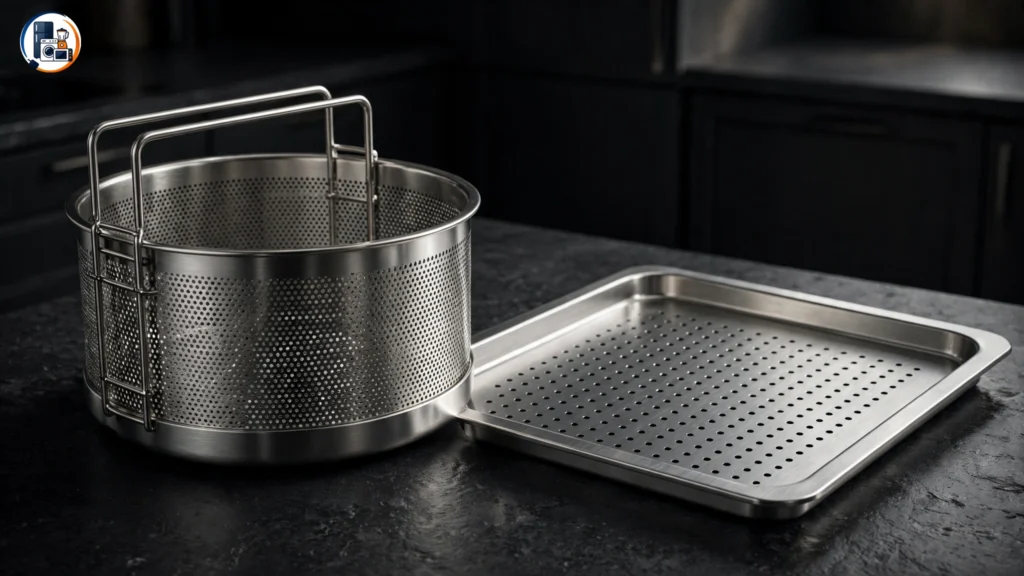
Stainless steel is attractive to shoppers because it can provide a durable, non-coated food-contact surface.
But once again, the exact construction matters.
A product can have:
- Stainless steel housing
- Stainless steel cooking basket
- Stainless steel rack
- Coated crisper plate
Those are not the same thing.
If you want a stainless steel cooking system, confirm that the actual food-contact parts are stainless steel rather than assuming the exterior tells the whole story.
A bare stainless steel surface also behaves differently from nonstick cookware. Food may stick more easily, and cleaning can require more attention.
That is not necessarily a disadvantage. It is simply the trade-off of choosing a surface without a conventional nonstick coating.
If stainless steel is your main priority, our guide to the best stainless steel air fryer can help you narrow down the options.
Are Glass Air Fryers a Better Option?
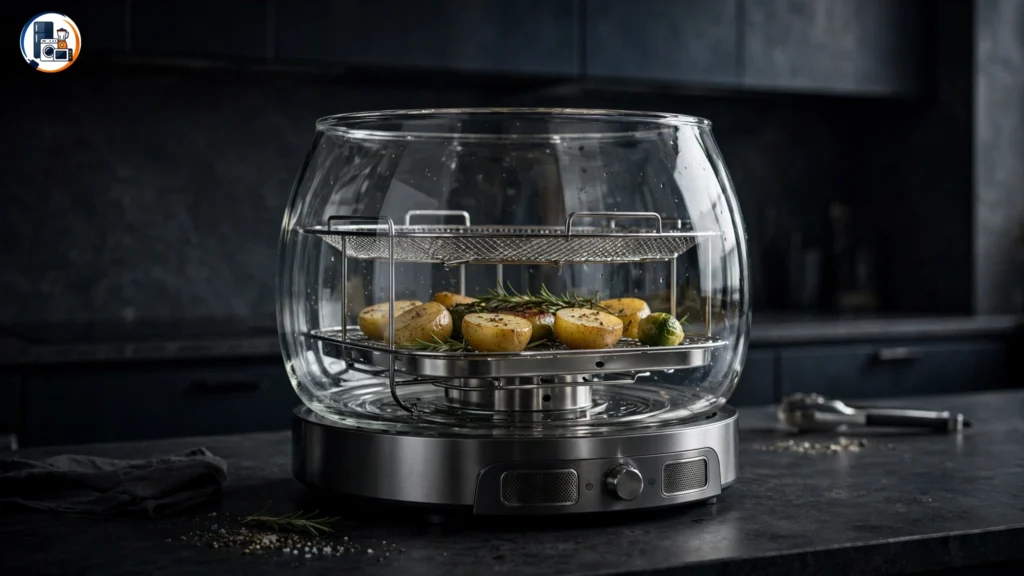
Glass offers another route for shoppers who want to minimize dependence on nonstick coatings.
A true glass air fryer uses glass as the main cooking vessel rather than merely putting a glass window in front of a conventional coated basket.
That distinction matters.
A glass-window air fryer is not necessarily a glass cooking system.
One current example is Fritaire, which lists a tempered-glass cooking bowl and 304 stainless steel accessories, with no food-contact coatings.
Potential advantages of glass
- No conventional nonstick coating on the glass cooking vessel
- Easy visibility while food cooks
- Can be paired with stainless steel accessories
- Useful for shoppers who specifically want to avoid coated baskets
Potential trade-offs
- Glass can be heavier than a conventional basket
- The overall appliance design can be different from a standard drawer-style fryer
- Accessories still need to be checked
- Glass is not automatically unbreakable simply because it is designed for cooking
If you’re considering a glass model, also see our guide on Can You Put Glass in an Air Fryer? for the difference between heat-resistant cookware and ordinary glass.
Don’t Forget the Crisper Plate and Accessories
This is one of the most overlooked parts of air fryer shopping.
You might carefully choose a PFAS-free basket and then forget about the crisper plate sitting inside it.
The same applies to:
- Racks
- Rotisserie baskets
- Grill plates
- Drip trays
- Baking accessories
A product description may say that the basket is ceramic-coated while providing a separate crisper plate with a different surface.
That doesn’t necessarily make the product bad. It simply means you should understand the complete food-contact setup.
A better question to ask
Instead of:
“Is the basket safe?”
Ask:
“What are all the surfaces that can directly touch my food?”
That produces a much more useful answer.
What About Scratched or Peeling Coatings?
A damaged coating deserves attention regardless of which coating type it uses.
If a basket has:
- Deep scratches
- Peeling areas
- Bubbling
- Flaking
- Exposed substrate
- Severe surface damage
Check the manufacturer’s care and replacement guidance.
Avoid deliberately scraping the surface with metal utensils or abrasive tools. A damaged cooking surface can also become harder to clean and may perform differently from the condition in which it was designed to operate.
The important point is not to jump from “scratched” directly to “toxic.”
Those are different claims.
A damaged coating is a reason to inspect, replace, or retire the component according to the manufacturer’s guidance. It is not enough evidence by itself to make a sweeping health claim about the material.
Material Comparison at a Glance
| Cooking Surface | Usually Coated? | Main Advantage | Main Consideration |
|---|---|---|---|
| PTFE-based nonstick | Yes. | Easy food release | Avoid if you specifically want PTFE-free. |
| Ceramic-coated | Yes. | Nonstick surface without PTFE in products specifically formulated that way | Verify the exact PFAS/PTFE claim. |
| Stainless steel | Usually no coating on the food-contact steel itself | Durable, simple material story | Food can stick more easily. |
| Glass | No coating on the glass itself | Avoids a coated cooking vessel | Weight, breakage, and accessory materials |
| Mixed-material design | Depends | Can combine convenience and durability | Requires model-level checking |
There is no universal winner.
The right choice depends on which trade-offs you care about most.
Marketing Claims You Should Be Careful With
Some phrases sound stronger than the information they actually provide.
“PFOA-free”
Useful, but narrow.
It tells you something about PFOA. It does not automatically establish that the entire product is PFAS-free or PTFE-free.
“Ceramic”
Useful as a material description, but incomplete by itself.
Find out whether the manufacturer explicitly identifies the cooking surface as PFAS-free and PTFE-free.
“Non-toxic”
Treat this as a marketing description rather than a complete technical specification.
Look for the actual material details behind the claim.
“Chemical-free”
This is a particularly weak phrase.
Everything around us is made of chemicals. What matters here is which materials are used, where they are used, and how they behave in their intended application.
“Stainless steel”
Find out whether the stainless steel is:
- The exterior body
- The basket
- The crisper plate
- The racks
- Or several of these
The label alone does not answer that.
How We Evaluate Air Fryer Material Claims
A useful evaluation should separate four things:
1. What the manufacturer says
For example:
“PFAS-free ceramic-coated basket.”
That is a manufacturer claim.
2. What the material actually is
Ceramic-coated, stainless steel, glass, PTFE-based nonstick, or another material.
3. Where that material is used
The basket and crisper plate matter more to this question than an exterior stainless steel panel.
4. What conclusion can reasonably be drawn?
Avoid jumping from a narrow specification to a much broader health conclusion.
This distinction is especially important for products marketed around “non-toxic” cooking.
For example, COSORI currently describes its Iconic model as using a stainless steel structure, tempered glass, and PFAS-free ceramic-coated basket and crisper plate. That is a specific model-level material description, not evidence that every COSORI air fryer uses the same construction.
Likewise, Fritaire currently lists tempered glass for its cooking bowl and 304 stainless steel for accessories, with no food-contact coatings.
Model-level information beats brand-level assumptions.
What to Look for When Buying
If avoiding PFAS or PTFE is important to you, don’t start with the color, capacity, or number of presets.
Start with the cooking surface.
Look for specific wording such as
- PFAS-free cooking surface
- PTFE-free cooking surface
- PFOA-free, if that specific issue matters to you
- Stainless steel food-contact surface
- Glass cooking bowl
- No food-contact coating
Then check whether the claim covers the basket, crisper plate, and other cooking accessories.
Also check the manual.
Product pages can simplify material descriptions. The owner’s manual and technical specifications may provide more detail about which components are coated, removable, dishwasher-safe, or subject to specific care requirements.
Examples of Different Material Designs
Current products show why it is better to compare construction rather than brand names.
Ceramic-coated basket design
COSORI’s iconic 6.5-quart model combines a stainless steel structure and tempered glass with ceramic-coated basket and crisper-plate surfaces that the manufacturer identifies as PFAS-free and PTFE-free.
Glass-and-stainless design
Fritaire’s current design uses a tempered-glass bowl with 304 stainless steel accessories and lists no food-contact coatings.
These are two very different approaches to the same consumer goal.
Neither should be reduced to a simple “good material versus bad material” argument.
Point Buying Checklist
Before buying an air fryer marketed as “non-toxic,” run through this list:
1. What touches the food?
Identify the basket, crisper plate, racks, and other cooking accessories.
2. Is there a coating?
If yes, find out what type.
3. Is the coating explicitly PTFE-free?
Do not infer this from the word “ceramic.”
4. Is it explicitly PFAS-free?
If that matters to you, look for the broader claim.
5. Is “PFOA-free” the only claim?
Remember that PFOA and PFAS are not interchangeable terms.
6. Does the claim apply to the exact model?
Do not assume that one model’s material specification applies to the entire brand.
7. What does the manual say?
Use the manufacturer’s care instructions to understand how the cooking surface should be used and maintained.
If a product page cannot clearly answer these questions, that’s useful information in itself.
What About Cooking Oil?
Oil is separate from the material question, but it can still affect how your air fryer performs.
A light amount of oil can improve browning and help some foods develop a better surface texture. The best choice depends on the food, cooking temperature, flavor, and how you plan to use the appliance.
For a deeper look at cooking oils and air fryer use, see our guide to the best oil for air fryers.
The important point is that changing your cooking oil does not change the material of the basket or coating.
FAQs
What is the safest material for an air fryer?
There is no single material that can be declared universally “safest” for every person and use. If your priority is avoiding nonstick coatings, a model using a bare stainless steel or glass food-contact surface may fit that preference. If you want easier food release, a specifically documented PFAS-free and PTFE-free ceramic-coated surface may be another option.
Are ceramic air fryers really non-toxic?
“Non-toxic” is a broad marketing term. A ceramic coating does not automatically tell you everything about its formulation. Look for a specific manufacturer statement about the exact model and whether the cooking surfaces are PFAS-free and PTFE-free.
Is PTFE dangerous in an air fryer?
PTFE should not automatically be described as dangerous simply because it is present. Food-contact safety depends on the material, intended use, and conditions. If you personally want to avoid PTFE, choose a model that explicitly identifies its food-contact surfaces as PTFE-free.
Is PFOA the same as PFAS?
No. PFOA is one specific substance within the broader PFAS family. A PFOA-free claim should not automatically be interpreted as a PFAS-free claim.
Are stainless steel air fryers better?
They can be a strong choice for shoppers who prefer an uncoated metal cooking surface. The trade-off is that stainless steel may not release food as easily as a nonstick surface. Also, verify that the basket and crisper plate are actually stainless steel rather than assuming the exterior material represents the entire cooking system.
Are glass air fryers safer?
Glass can be attractive if you want a cooking vessel without a conventional nonstick coating. But you should still check the material of the accessories that directly touch food. A glass bowl does not automatically mean every component is glass or stainless steel.
Does “ceramic” mean PFAS-free?
Not automatically. Some manufacturers specifically identify their ceramic-coated cooking surfaces as PFAS-free and PTFE-free, but the word “ceramic” alone is not enough to establish that.
What should I do if my air fryer coating is peeling?
Stop treating the damaged surface as normal wear. Check the manufacturer’s instructions and replacement options. Avoid scraping it further with metal utensils or abrasive tools. If the coating is substantially peeling or damaged, replacing the affected component is the sensible approach.
Are “chemical-free” air fryers real?
The phrase is misleading. Air fryers are made from materials and therefore involve chemistry. A better question is which materials and coatings are used on the surfaces that contact your food.
Is a PFAS-free air fryer automatically better?
Not necessarily for everyone. PFAS-free may be an important preference, but you still need to consider cooking performance, durability, capacity, cleaning, price, and the materials of the complete cooking system.
Final Conclusion
The smartest way to shop for a non-toxic air fryer is to ignore the label for a moment and investigate the construction underneath it.
“Non-toxic,” “PFOA-free,” “ceramic,” “stainless steel,” “PFAS-free,” and “PTFE-free” are not interchangeable claims. Each tells you something different.
If avoiding PFAS or PTFE is your priority, look for specific model-level information about the food-contact surfaces, especially the basket and crisper plate. A clearly documented PFAS-free and PTFE-free ceramic surface can offer nonstick convenience, while bare stainless steel or a glass cooking vessel may appeal more to shoppers who want to minimize coated cooking surfaces.
There is no magic material that makes every air fryer perfect.
The better strategy is simple:
Check what touches your food. Check the exact claim. Check the exact model. Then judge the trade-offs.
Don’t buy the label. Investigate the material.